

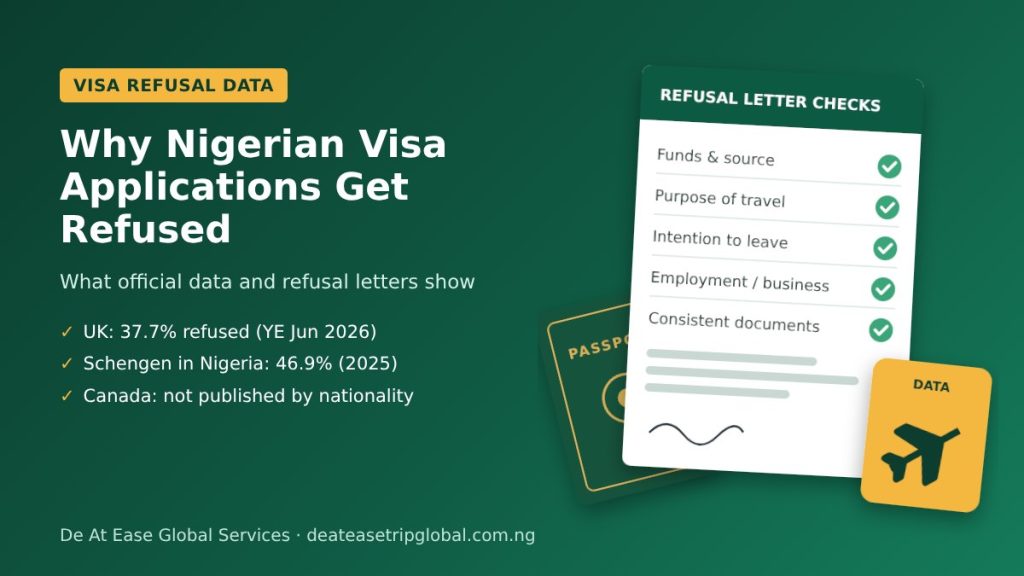
Quick answer: Why Nigerian visa applications get refused is best answered with evidence, not rumours. Official figures show that refusals are common but far from universal. In the year ending June 2026, the UK refused 37.7% of decided visit visa applications from Nigerian nationals, according to Home Office data. In 2025, Schengen consulates in Nigeria did not issue a visa for 46.9% of short-stay applications, according to the European Commission. Canada does not publish visitor visa refusal figures by nationality in its open data. Behind every refusal is an individual decision based on the rules: whether the applicant showed a genuine purpose, adequate and explained funds, and an intention to leave at the end of the visit. Your refusal letter is the most useful document for understanding your own case.
Visa refusals cost Nigerian travellers money, time and confidence. They also attract a great deal of speculation on social media, from “embassies hate Nigerians” to “you need ₦10 million in your account”. This article takes a different approach. It examines official UK, Schengen and Canadian sources, explains exactly what each dataset measures, and shows what refusal letters can tell you about an individual application.
What the official data says about Nigerian visa refusals
Official data at a glance
| Destination | Reporting period | Applications | Approvals | Refusals | Refusal rate | What is measured | Official source |
|---|---|---|---|---|---|---|---|
| UK | Year ending June 2026 | 168,856 decisions (incl. 111 withdrawn) | 105,187 issued | 63,558 | 37.7% | All visit visas, Nigerian nationals worldwide | Home Office, Vis_D02 |
| Schengen Area | 2025 | 113,359 applications | 57,061 issued (+699 limited territorial validity visas) | 53,196 not issued | 46.9% | Short-stay (uniform) visas lodged at consulates in Nigeria | European Commission |
| Canada | Not applicable | Not published in the selected dataset | Not published in the selected dataset | Not published in the selected dataset | Not published in the selected dataset | IRCC open data does not break down visitor visa decisions by citizenship | IRCC statistics |
How the rates were calculated:
- UK: refused ÷ (issued + refused). Withdrawn and lapsed applications are excluded. We calculated the figures from the Home Office “Entry clearance visa applications and outcomes” dataset (Vis_D02), year ending June 2026, filtering for Nigerian nationality and the Visitor visa group. This group covers all visit visas, not only Standard Visitor visas.
- Schengen: visas not issued ÷ uniform visa applications at consulates located in Nigeria (Abuja and Lagos). The European Commission’s own “not issued rate” uses issued + limited territorial validity visas + not issued as the base, which gives 47.9% for 2025.
Why these figures cannot be compared directly
- Different populations. UK data covers Nigerian nationals applying anywhere in the world. Schengen data covers applications lodged at consulates in Nigeria, which are mostly, but not only, from Nigerians.
- Different visa scopes. The UK figure covers all visit visas; the Schengen figure covers uniform short-stay visas.
- Different periods. The UK figure covers July 2025 to June 2026; the Schengen figure covers calendar year 2025.
- Different systems. Each country applies its own rules and assessment approach.
A higher or lower rate does not mean one country is “easier”. It describes past outcomes for a whole group of applicants, not your individual chance.
UK visa refusals for Nigerians
What the Home Office figures show
| Year ending June | Issued | Refused | Withdrawn | Refusal rate |
|---|---|---|---|---|
| 2022 | 69,333 | 44,772 | 441 | 39.2% |
| 2023 | 102,711 | 64,612 | 563 | 38.6% |
| 2024 | 97,307 | 56,201 | 190 | 36.6% |
| 2025 | 105,456 | 68,123 | 185 | 39.2% |
| 2026 | 105,187 | 63,558 | 111 | 37.7% |
Source: Home Office, Immigration system statistics data tables, “Entry clearance visa applications and outcomes detailed datasets, year ending June 2026”, table Vis_D02. Nigerian nationals, Visitor visa group, all applicant types. Refusal rate = refused ÷ (issued + refused).
Key observations:
- More than 100,000 UK visit visas were issued to Nigerians in each of the last four reporting years.
- The refusal rate has stayed between about 36% and 40% since the year ending June 2022.
- For calendar year 2025, the same dataset shows 104,898 visas issued and 64,941 refused, a refusal rate of 38.2%.
The Home Office does not publish refusal reasons by nationality in these tables, so no official statistic shows which reasons are most common for Nigerians.
What UK guidance says about genuine visitors
GOV.UK states that you must show you will leave the UK at the end of your visit, can support yourself, and can pay for your return journey (Standard Visitor visa). The guide to supporting documents says financial documents should clearly show you have access to the funds, such as bank statements that detail the origin of the funds held.
The Home Office’s Visit caseworker guidance adds that travel history and compliance are relevant, but travel history “should not be the only consideration”.
What UK refusal letters reveal
UK refusal letters set out the reasons for the decision and refer to the relevant rules. They usually explain which requirements the decision maker was not satisfied about, such as the source of funds or the purpose of the visit. Most visitor refusals carry no right of appeal, so a strong new application that addresses the reasons is usually the next step. See our guides to UK visitor visa requirements for Nigerians and UK visa refusals.
Schengen visa refusals for Nigerians
What the European Commission figures show
| Year | Applications at consulates in Nigeria | Uniform visas issued | Limited territorial validity visas | Not issued | Not issued ÷ applications |
|---|---|---|---|---|---|
| 2022 | 86,815 | 46,404 | 362 | 39,189 | 45.1% |
| 2023 | 105,926 | 62,099 | 207 | 42,940 | 40.5% |
| 2024 | 111,201 | 58,808 | 498 | 50,376 | 45.3% |
| 2025 | 113,359 | 57,061 | 699 | 53,196 | 46.9% |
Source: European Commission, visa statistics for consulates, annual files for 2022–2025, sheet “Data for consulates”, all Schengen consulates in Nigeria. Applications do not always equal decisions, because some cases are withdrawn, discontinued or carried into the next year.
Differences between Schengen states
| Schengen state (consulates in Nigeria) | Applications 2024 | Not issued 2024 | Applications 2025 | Not issued 2025 |
|---|---|---|---|---|
| France | 55,833 | 43.5% | 58,583 | 47.4% |
| Italy | 13,703 | 37.8% | 13,563 | 42.5% |
| Spain | 12,968 | 59.2% | 9,489 | 52.7% |
| Germany | 9,319 | 36.2% | 7,712 | 29.1% |
| Belgium | 5,690 | 62.3% | 7,461 | 60.3% |
| Switzerland | 2,816 | 20.6% | 2,597 | 27.2% |
Same source and method as above.
These differences reflect different applicant profiles as well as different decisions. You must apply to the Schengen country that is your main destination, so the figures should never be used to choose a consulate. Read our guide to European countries Nigerians can visit.
Nigerian nationals worldwide versus applications in Nigeria
The European Commission’s consulate dataset is organised by where the application was lodged, not by the applicant’s nationality. It therefore measures applications at consulates in Nigeria, which include a small number of non-Nigerian residents and exclude Nigerians who applied elsewhere. We did not find a nationality-based Schengen refusal figure for Nigerians in the Commission’s published consulate tables.
Legal grounds for Schengen refusals
Article 32 of the EU Visa Code lists the grounds for refusal. They include a false travel document, no justification for the purpose and conditions of the stay, insufficient means of subsistence, an alert in the Schengen Information System, a threat to public policy or health, no adequate travel medical insurance, and reasonable doubts about the authenticity of documents, the reliability of statements or the intention to leave. Refusals are notified on a standard form that marks the grounds used. See our full guide to Schengen visa refusal for Nigerians.
Canadian visitor visa refusals for Nigerians
What official data is available
IRCC’s statistics and open data include national visitor visa totals and detailed data for other programmes, such as permanent residents by citizenship. However, we did not find an official open dataset that gives visitor visa (temporary resident visa) approvals and refusals for Nigerian citizens. We have therefore not included a Canadian refusal rate. Figures circulating online that are not traceable to an IRCC publication should be treated with caution.
Do not confuse visitor visa statistics with study permit, work permit or permanent residence statistics. These are separate programmes with different rules.
How Canadian visitor visa applications are assessed
According to IRCC’s eligibility guidance, you must, among other things:
- have a valid travel document
- be in good health
- have no criminal or immigration-related convictions
- convince an officer that you have ties, such as a job, home, financial assets or family, that will take you back home
- convince an officer that you will leave Canada at the end of your visit
- have enough money for your stay
IRCC’s application guidance recommends documents such as bank statements showing at least six months of account details, an employer letter and travel history.
Refusal letters and your file
IRCC states that your decision in your online account will explain why the application was refused. Applicants can also request their personal information held by IRCC, which may include officers’ notes, through a Privacy Act request. IRCC says there are no fees for processing such a request. See our guide to Canada visa refusal reasons for Nigerians.
What visa refusal letters actually reveal
How the three systems explain decisions
| UK | Schengen | Canada | |
|---|---|---|---|
| Format | Written refusal notice with reasons | Standard refusal form with marked grounds | Refusal letter in your IRCC account |
| Level of detail | Usually specific to the evidence | Grounds marked; detail varies by consulate | Grounds stated; more detail may be available through a Privacy Act request |
| Appeal | Most visitor refusals: no right of appeal | Right to appeal under the refusing state’s national law | IRCC’s refusal guidance describes no internal appeal; applicants can reapply, and some seek legal advice on Federal Court review |
| Published national statistics on reasons | Not by nationality in the outcome tables | Not by nationality | Not found in open data |
Recurring themes in refusal explanations
The themes below commonly appear in refusal letters. They are not statistically proven top reasons for Nigerians, because none of the three authorities publishes nationality-level refusal-reason statistics in the datasets reviewed.
- insufficient evidence of funds
- unclear source of funds
- unexplained large deposits
- unconvincing purpose of travel
- inconsistent information
- insufficient evidence of employment or business activity
- concerns about the applicant’s intention to leave
- weak sponsorship evidence
- doubts about supporting documents
- failure to meet a specific visa requirement
Separating evidence types
| Type of information | Example | How reliable for generalising? |
|---|---|---|
| Official statistics | Home Office and European Commission refusal numbers | Reliable for rates; no nationality-level reasons |
| Legal grounds | Article 32 Visa Code; UK Immigration Rules; IRCC eligibility | Defines what can lead to refusal |
| Individual refusal letters | “I am not satisfied that the funds are available to you” (example wording) | Specific to one case |
| Professional observations | Patterns advisers see in client files | Useful, but not statistical evidence |
Why bank statements matter
Officers look at more than your closing balance. They ask whether the money is genuinely yours, where it came from, and whether the trip makes sense alongside your income and commitments.
- Balances alone do not tell the whole story. A steady pattern of income and spending is more convincing than a sudden peak.
- Unexplained deposits raise questions. A large credit just before applying needs documentary proof, such as a sale agreement or bonus letter.
- Irregular business income can be documented with invoices, contracts and business statements.
- Sponsors should provide their own statements, proof of income and proof of relationship.
- Artificial deposits and manipulated statements are dangerous. Deception can lead to refusal and long bans, such as the UK’s 10-year ban under the Immigration Rules.
Fictional example: Chinedu, an Abuja engineer, received ₦7.5 million from a land sale two weeks before applying. He included the sale agreement and buyer’s payment record, so the source was clear.
For detail, read how much money you should have in your bank account and how to prepare a bank statement for a visa.
Why employment and business evidence matter
Your circumstances in Nigeria help explain why you will return. Useful evidence includes:
- employment letters confirming role, salary and approved leave
- payslips that match bank credits
- CAC business registration
- business bank statements
- tax documents, where relevant
- contracts and invoices
- evidence of ongoing business activity
- school or university letters for students
- sponsorship documents
You do not have to be a salaried employee to qualify for a visitor visa. Read our guide on applying for a visa without a job.
Fictional example: Hauwa, a Kano textile trader, submitted her CAC documents, business statements and personal statements showing monthly transfers from her business, making her income easy to follow.
Does travel history determine visa approval?
Travel history is your record of previous trips and how you complied with visa conditions. It is not compulsory. The UK caseworker guidance says decision makers must rely on other evidence for first-time travellers, and IRCC lists travel history as a recommended, not required, document. Previous travel can help, but it does not guarantee approval. Read can Nigerians get a visa without travel history.
What to do after a visa refusal
- Read the refusal letter carefully.
- Identify the actual grounds used in your case.
- Request more information where available, such as a Privacy Act request in Canada.
- Check whether an appeal or review is available. Rights differ: most UK visitor refusals have no appeal; Schengen appeals follow the refusing state’s national law; for Canada, IRCC’s refusal guidance does not describe an internal appeal, so most applicants reapply, while some seek legal advice about review by the Federal Court.
- Decide whether a fresh application is more appropriate.
- Correct the identified weaknesses before reapplying.
How Nigerians can reduce the risk of visa refusal
- Correct visa category for your real purpose.
- Accurate application information, checked against every document.
- Genuine supporting documents only.
- Clear financial evidence, with explained deposits.
- A credible travel purpose, with invitations or bookings.
- Accommodation arrangements that cover your whole stay.
- Employment or business evidence that matches your bank activity.
- Proper sponsorship documents, where someone else is paying.
- Honest disclosure of immigration history, including previous refusals.
- Consistency across all documents.
- Destination-specific requirements, including the correct Schengen consulate.
No checklist guarantees approval, but each step removes avoidable doubts. Also read our guide to common visa application mistakes. For destination-specific guidance, see our articles on China visa requirements for Nigerians and Canada visa requirements.
How De At Ease Global Services can help
De At Ease Global Services helps Nigerian travellers prepare honest, well-organised applications. Our services include visa application guidance, document checklist preparation, travel documentation support, flight booking, hotel reservations and travel planning. We cannot influence embassy decisions, overturn refusals or guarantee approval. Before choosing any agent, read how to verify a visa agent in Nigeria.
Preparing an application or recovering from a refusal? Book a consultation or explore our visa assistance services.
Related guides: Visa Updates for Nigerians, November 2026.
Frequently asked questions
Why do Nigerian visa applications get refused?
Usually because the applicant did not satisfy the decision maker on one or more requirements, such as funds, purpose of travel or intention to leave. The exact reasons are in each refusal letter.
Which country has the highest visa refusal rate for Nigerians?
The available official figures are not directly comparable, because they measure different populations, visa types and periods. Canada does not publish a comparable nationality figure in its open data.
What percentage of Nigerians are refused UK visitor visas?
Home Office data shows a refusal rate of 37.7% for Nigerian nationals’ visit visa decisions in the year ending June 2026 (refused ÷ issued plus refused).
What is the Schengen visa refusal rate for Nigeria?
In 2025, 46.9% of short-stay applications at Schengen consulates in Nigeria did not result in a visa, according to European Commission data (47.9% using the Commission’s own formula).
What is Canada’s visitor visa refusal rate for Nigerians?
We did not find an official IRCC open dataset that publishes this figure.
Can I see why my visa application was rejected?
Yes. UK, Schengen and Canadian refusals all state reasons. In Canada, you can also request your file under the Privacy Act.
Do embassies explain visa refusal reasons?
Yes, in writing, although the level of detail varies by country and consulate.
Can I reapply immediately after a visa refusal?
Generally yes, but you should fix the reasons first. Check the destination’s guidance.
Does a UK visa refusal affect a Schengen application?
Schengen consulates assess their own criteria. If asked about previous refusals, answer honestly.
Does a Schengen visa refusal affect a UK application?
The UK application asks about your immigration history. Answer honestly; a refusal is considered alongside your other evidence.
Can I apply for another visa after being refused?
Yes. Each application is assessed on its own merits.
Does a large bank deposit cause visa refusal?
Not on its own. An unexplained large deposit can raise doubts. Document its source.
Can I get a visa without having a job?
Yes. You need to show genuine funding and ties to Nigeria.
Can I get a visa without previous travel history?
Yes. Travel history is helpful but not compulsory.
Should I appeal or submit a fresh visa application?
It depends on the destination’s rules and your refusal reasons. Appeals suit clear errors; fresh applications suit fixable gaps.
Conclusion
Why Nigerian visa applications get refused is not a mystery hidden in social media rumours. Official data shows that many Nigerians are approved every year, while refusal rates remain significant. Your own refusal letter, read alongside the official rules, is the best guide to what went wrong and how to improve.
Methodology note: UK figures were extracted from the Home Office Vis_D02 dataset (year ending June 2026 release) and Schengen figures from the European Commission’s 2022–2025 consulate files. Calculations are by De At Ease Global Services and may differ slightly from headline figures that use other formulas. Data accessed on 10 November 2026.
De At Ease Global Services is an independent travel consultancy and is not affiliated with any embassy, government or visa application centre. This article is for general information and is not legal advice.