

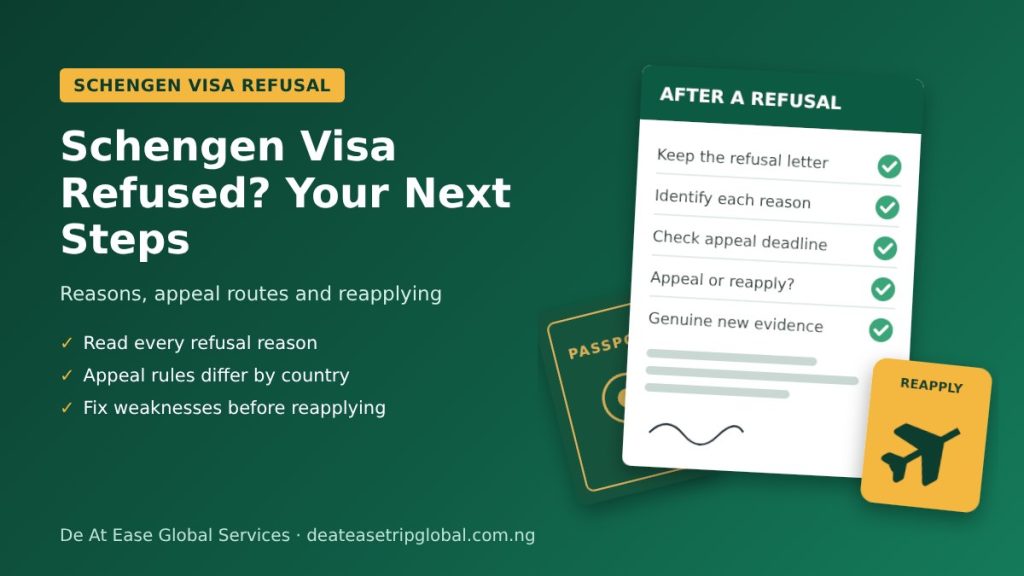
Quick answer: A Schengen visa refusal in Nigeria means the consulate was not satisfied that you met one or more conditions of the EU Visa Code. Every refused applicant has a legal right to appeal, but the appeal is made against the country that refused you and follows that country’s national law. Deadlines, authorities and costs therefore differ. For example, France requires an administrative appeal within 30 days, while Germany no longer accepts objections at its missions and directs appeals to the Berlin Administrative Court within one month. You can also submit a fresh application at any time, but you will usually pay a new fee, and you should fix the reasons for the first refusal before reapplying.
For the bigger picture, our data guide explains why Nigerian visa applications get refused, using official UK, Schengen and Canadian sources.
A refusal is disappointing, especially after paying fees and gathering documents. However, rushing into a new application with the same weaknesses often leads to a second refusal. This Schengen visa refusal Nigeria guide explains what a refusal means, why Nigerian applications are commonly refused, how appeals work and how to reapply with a stronger, genuine application.
What is a Schengen visa refusal?
A refusal is a formal decision by a Schengen consulate not to issue the visa you applied for. Under Article 32 of the EU Visa Code, a visa must be refused if you fail to meet certain conditions, or if there are reasonable doubts about your documents, statements or intention to leave.
How you are notified
The Visa Code requires the consulate to notify you of the refusal and its reasons using a standard refusal form. You usually collect it with your passport from the visa application centre. The form shows:
- the consulate that made the decision
- your name and application details
- the reason or reasons for refusal, marked on the form
- information on how to appeal
What the refusal reasons mean
The standard form lists refusal grounds, often called “refusal codes”, taken from Article 32. The consulate marks the ones that apply to you. The grounds include:
- a false, counterfeit or forged travel document
- no justification for the purpose and conditions of the intended stay
- no proof of sufficient means of subsistence for the stay and return
- having already stayed 90 days in the current 180-day period
- an alert in the Schengen Information System (SIS) for refusing entry
- being considered a threat to public policy, internal security or public health
- no adequate and valid travel medical insurance
- reasonable doubts about the authenticity of supporting documents, the reliability of your statements or your intention to leave the Schengen area before the visa expires
The refusal is also recorded in the Visa Information System (VIS), which other Schengen consulates can access.
Schengen visa refusal Nigeria: common reasons applications are refused
Each application is assessed individually. Not every Nigerian applicant faces the same assessment, and the reasons below will apply differently depending on your circumstances.
1. Insufficient financial evidence
You must show enough money for your stay and return journey. Each Schengen country sets its own reference amount. If your balance looks too low for your planned trip, the consulate may decide you cannot support yourself. See how much money you should have in your bank account.
2. Unclear source of funds
Having money is not enough. Officers want to know where it came from. A balance with no visible income pattern raises questions.
3. Unexplained large bank deposits
Large credits shortly before applying, without documents explaining them, can suggest borrowed or temporary funds. Read our guide on how to prepare a bank statement for a visa.
4. Incomplete supporting documents
Missing documents, such as an employer letter, invitation or insurance certificate, can lead to a refusal for failing to justify your trip.
5. Unclear travel purpose
If the consulate cannot understand why you are travelling, it may refuse on the ground that the purpose and conditions of the stay are not justified.
6. Inconsistent information on the application form
Dates, addresses, employment details or travel plans that differ between your form and documents damage your credibility.
7. Doubts about your intention to leave
This is one of the most common grounds. It usually arises when ties to Nigeria (job, business, family, property, studies) are not clearly shown.
8. Weak evidence of employment or business activity
Unverifiable employer letters, missing payslips or business documents that do not match bank activity can weaken your case.
9. Inadequate travel itinerary
An itinerary that does not match your application, or plans that are vague, unrealistic or inconsistent with the consulate you applied to, can lead to a refusal.
10. Unconvincing accommodation arrangements
Hotel bookings that do not cover your stay, or an invitation from a host without proof of their address, may raise doubts.
11. Invalid or inadequate travel medical insurance
Insurance must meet Schengen requirements, including minimum cover of €30,000 for emergency medical care, hospital treatment and repatriation, valid throughout the Schengen area for your stay.
12. Doubts about the authenticity of documents
If the consulate suspects a document is false or altered, it can refuse the visa. This can also affect future applications.
13. Previous immigration violations
Overstaying a previous visa or breaching its conditions can lead to refusal or an SIS alert.
14. Unclear sponsorship arrangements
If someone else is paying, the consulate needs evidence of the sponsor’s relationship, finances and commitment.
15. Failure to meet the destination’s requirements
Each Schengen country publishes its own checklist. Applying to the wrong consulate for your main destination, or missing a country-specific requirement, can lead to refusal. See which European country to apply to.
Understanding your Schengen visa refusal letter
How to read the refusal letter
- Check the consulate and country that refused the visa. This determines your appeal route.
- Note the date of the decision and the date you received it. Appeal deadlines usually run from notification.
- Identify every ground marked. There may be more than one.
- Read the appeal information included in the letter.
Turn reasons into weaknesses
Match each ground to a specific part of your application. For example, “intention to leave could not be ascertained” may point to weak employment evidence or an unclear travel history. “Means of subsistence” points to your bank statements.
Why you should not ignore the reasons
Reapplying without addressing the stated reasons is one of the most common causes of repeat refusals. The next consulate can see the earlier refusal in VIS.
Keep the letter safe
Keep the original refusal letter and a scanned copy. You may need it for an appeal, a future Schengen application, or applications to other countries that ask about previous refusals.
Illustrative example (not an official document)
Example only. Adaeze, a Lagos-based accountant, receives a refusal from a Schengen consulate. Two grounds are marked: purpose and conditions of stay not justified, and intention to leave could not be ascertained. Reviewing her file, she sees that she submitted no hotel booking for half of her trip and no leave approval from her employer. These are the weaknesses to fix.
Can Nigerians appeal a Schengen visa refusal?
Yes. Article 32(3) of the Visa Code states that applicants who have been refused a visa shall have the right to appeal. It also says that appeals are conducted against the Member State that took the final decision and in accordance with that Member State’s national law.
This means:
- The appeal authority depends on the country that refused you, not on where you applied in Nigeria.
- Deadlines, fees, language and format differ by country.
- The refusal letter must contain information about the appeal procedure.
Country examples (verified from official sources)
| Refusing country | Appeal route | Deadline | Cost |
|---|---|---|---|
| France | Mandatory administrative appeal (RAPO) to the sous-directeur des visas, Ministry of the Interior. If rejected, appeal to the Administrative Court of Nantes | 30 days from notification. No reply within 2 months means implicit rejection. Court: 2 months after rejection | Not stated on the official page |
| Germany | Remonstration to the embassy or consulate was abolished from 1 July 2025. Appeal by lawsuit at the Berlin Administrative Court | 1 month from notification | Court fees, currently about €480 per applicant according to the German mission; lawyer fees extra if used |
Sources: Service-Public.fr (France, checked 13 August 2026) and German missions in Nigeria (Germany).
For other countries, such as Italy, Spain, Belgium or the Netherlands, follow the appeal instructions on your refusal letter and the refusing embassy’s official website. Do not rely on another country’s rules.
What happens after you appeal?
The authority reviews whether the decision was lawful and correct, based on your file and the evidence you submit. Outcomes may include confirming the refusal or instructing the consulate to issue the visa. Timescales vary. Germany’s mission warns that court processing can take several months.
How to appeal a Schengen visa refusal: step by step
- Collect the refusal notification and keep the original.
- Read every stated reason carefully.
- Identify the legal and factual issues. Was there a misunderstanding, a missing document or a genuine weakness?
- Check the appeal instructions for the refusing country, including the deadline, authority, language and costs.
- Prepare supporting evidence that directly addresses each reason.
- Draft an appeal letter where required, clearly and respectfully, in the required language.
- Submit through the correct authority before the deadline.
- Keep proof of submission, such as a receipt or confirmation email.
- Monitor the outcome and note any further deadlines.
When an appeal may be appropriate: where you believe the consulate made a clear error, missed a document you submitted or misread your circumstances, and your travel date allows time for the process.
When a fresh application may be better: where the refusal reflects genuine gaps in your evidence that you can now fix, or where your travel is soon and an appeal may take too long.
How to reapply after a Schengen visa refusal from Nigeria
Can you reapply?
Yes. Germany’s mission, for example, states that you may submit a new application at any time. There is no general EU waiting period, but check the refusing country’s guidance.
Do you need to fix the refusal reasons?
You are not legally required to wait, but you should address the reasons before reapplying. A new application with the same weaknesses is likely to meet the same concerns.
Is there a new fee?
Yes, normally. A new application is a new case with a new visa fee (€90 for adults under the Visa Code) plus any visa centre service charges.
Do you have to disclose the earlier refusal?
Answer every application question truthfully. Refusals are recorded in VIS, so consulates can see them. If the form or checklist asks about previous refusals, include the details and the refusal letter.
Will the refusal affect future applications?
A refusal does not automatically lead to another one, but it forms part of your history. A refusal based on false documents is far more serious than one based on missing evidence.
Step-by-step reapplication guide
- Review the refusal reasons and your original file.
- Check whether you are applying to the correct consulate for your main destination.
- Gather updated, genuine documents that address each reason.
- Write a brief cover letter explaining what has changed.
- Book a new appointment and pay the new fee.
- Submit a complete and consistent application.
Appeal or reapply? Which is better?
| Appeal | Fresh application | |
|---|---|---|
| When it may suit you | The consulate made a clear error or overlooked evidence | Your original application had genuine gaps you can now fix |
| Possible advantages | Challenges the decision itself; may correct an unfair refusal | Can be quicker; lets you submit new and improved evidence |
| Limitations | Strict deadlines; may take months; costs and language vary by country | New fee; previous refusal remains on record |
| Important considerations | Follow the refusing country’s national procedure exactly | Do not repeat the same weaknesses |
The right choice depends on your refusal reasons, your travel dates and the national procedure of the refusing country. If you are considering a court appeal, you may wish to seek advice from a qualified lawyer.
Documents to prepare before reapplying
Provide only documents that are relevant to your circumstances and the official checklist:
- valid international passport (and previous passports)
- completed visa application form
- copy of the previous refusal letter
- updated bank statements
- evidence of income (payslips, invoices, business records)
- employment letter with approved leave, or business documents
- sponsorship letter and sponsor’s documents, where applicable
- travel itinerary
- accommodation evidence
- travel medical insurance meeting Schengen requirements
- evidence of the purpose of travel (invitation, conference registration)
- evidence of ties to Nigeria (family, property, studies, business)
- a short explanation addressing each previous refusal reason
How to avoid another Schengen visa refusal
- Complete the form accurately. Check every date and detail.
- Use genuine financial documents. Never alter or “regenerate” statements.
- Explain unusual transactions with sale agreements, contracts or employer letters.
- Show your real purpose with invitations, bookings or event registrations.
- Make credible travel arrangements with flight bookings and hotel reservations that match your plans.
- Choose the correct consulate based on your main destination.
- Keep everything consistent across all documents.
- Never submit false documents or misleading information.
Fictional Nigerian examples
These are fictional illustrations, not real customer cases.
Employee applying for France. Tolu, a Lagos HR officer, was refused because her employer letter did not confirm approved leave. She asks HR for a letter confirming her role, salary and leave dates, and reapplies with a complete hotel booking.
Business owner applying for Germany. Musa, a Kaduna agro-dealer, was refused for insufficient proof of means. His company account was strong, but his personal account showed little activity. Because Germany no longer accepts objections at its missions, he chooses to reapply with personal statements showing regular transfers from his business.
Self-employed applicant with irregular transactions. Ebuka, a freelance video editor in Enugu, had several large foreign payments with no explanation. He reapplies with client contracts and invoices matching each credit.
Sponsored applicant with incomplete documents. Blessing, 23, was sponsored by her uncle, but only his bank statement was submitted. She reapplies with his sponsorship letter, proof of income and evidence of their relationship.
First-time traveller with an unclear purpose. Kelechi, from Owerri, listed “tourism” but provided no itinerary. He prepares a day-by-day plan with matching bookings before applying again.
How De At Ease Global Services can help
De At Ease Global Services supports Nigerian travellers with:
- visa application guidance
- travel documentation support
- document checklist preparation
- flight arrangements
- hotel reservations
- travel planning
- general visa application assistance
If you have received a Schengen visa refusal, we can help you understand the reasons stated, review your documents and prepare a stronger, genuine new application. We do not provide legal representation, cannot overturn embassy decisions and cannot influence visa officers. Decisions rest entirely with the consulate.
Related guides: Easiest Schengen Visa Country for Nigerians and France Tourist Visa from Nigeria (2026).
Frequently asked questions
Can I apply for another Schengen visa after rejection?
Yes. You can submit a new application. Address the original refusal reasons first.
How soon can I reapply after a Schengen visa refusal?
There is no general EU waiting period. Germany, for example, says you may reapply at any time. Check the refusing country’s guidance.
Can I appeal a Schengen visa refusal from Nigeria?
Yes. The Visa Code gives every refused applicant the right to appeal, under the national law of the refusing country.
How long does a Schengen visa appeal take?
It depends on the country. In France, no reply to the administrative appeal within two months counts as a rejection. Germany’s mission says court cases usually take several months.
Does a Schengen visa refusal affect future applications?
It is recorded in VIS and may be considered, but it does not automatically lead to another refusal if your new application is strong.
Can I apply to another Schengen country after a refusal?
Only if that country is genuinely your main destination. Applying elsewhere to avoid the refusing consulate is not appropriate.
Must I declare a previous Schengen visa refusal?
Answer all questions truthfully. If the form or checklist asks, disclose it and include the letter.
Will I pay another visa fee when reapplying?
Yes, normally. A new application requires a new fee.
Can I get a refund after a Schengen visa refusal?
No. Under Article 16 of the Visa Code, the visa fee is not refundable when a visa is refused.
Can I appeal without hiring a lawyer?
It depends on the country. Germany’s mission says a lawyer is optional for a court action, although proceedings are conducted in German. Check the refusing country’s rules, and consider legal advice for complex cases.
What happens if my Schengen visa appeal is rejected?
Depending on the country, there may be a further court stage. For example, in France, a rejected administrative appeal can be taken to the Administrative Court of Nantes. Otherwise, you can submit a new application.
Can I apply for a UK visa after a Schengen visa refusal?
Yes. The UK has its own visa system. Answer any questions about previous refusals honestly. See our guide to UK visitor visa requirements for Nigerians.
Conclusion
A Schengen visa refusal is not the end of your travel plans. Read the refusal letter carefully, understand each ground, check the refusing country’s appeal rules and decide whether an appeal or a stronger fresh application suits your situation. Whatever you choose, genuine documents and consistent information are your best foundation.
Received a Schengen visa refusal? Before submitting another application, book a consultation with De At Ease Global Services or explore our Schengen visa assistance service. For more background, read our guides to Schengen visa requirements for Nigerians and what Schengen embassies really check.
De At Ease Global Services is an independent travel consultancy and does not provide legal representation. We are not affiliated with any embassy, the European Commission or any visa application centre. Procedures change; always follow the instructions on your refusal letter and the refusing country’s official website.