

Easiest Schengen visa country for Nigerians:
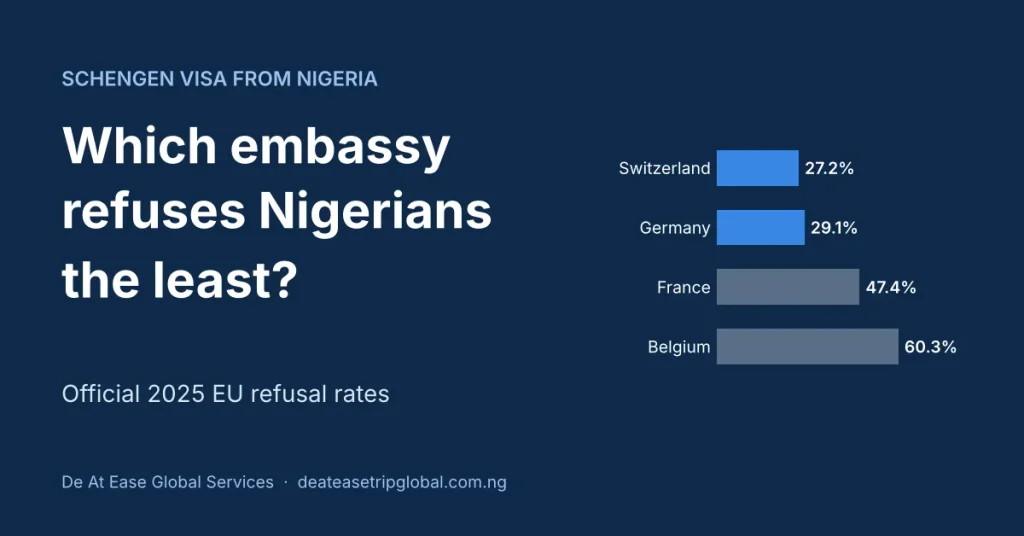
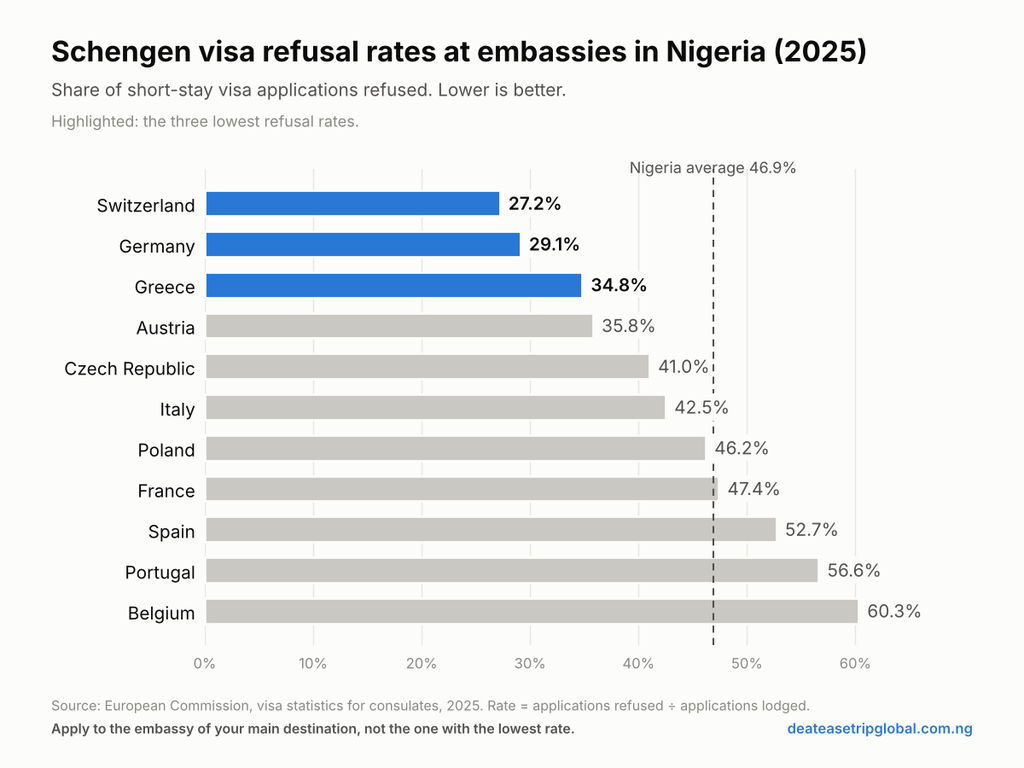
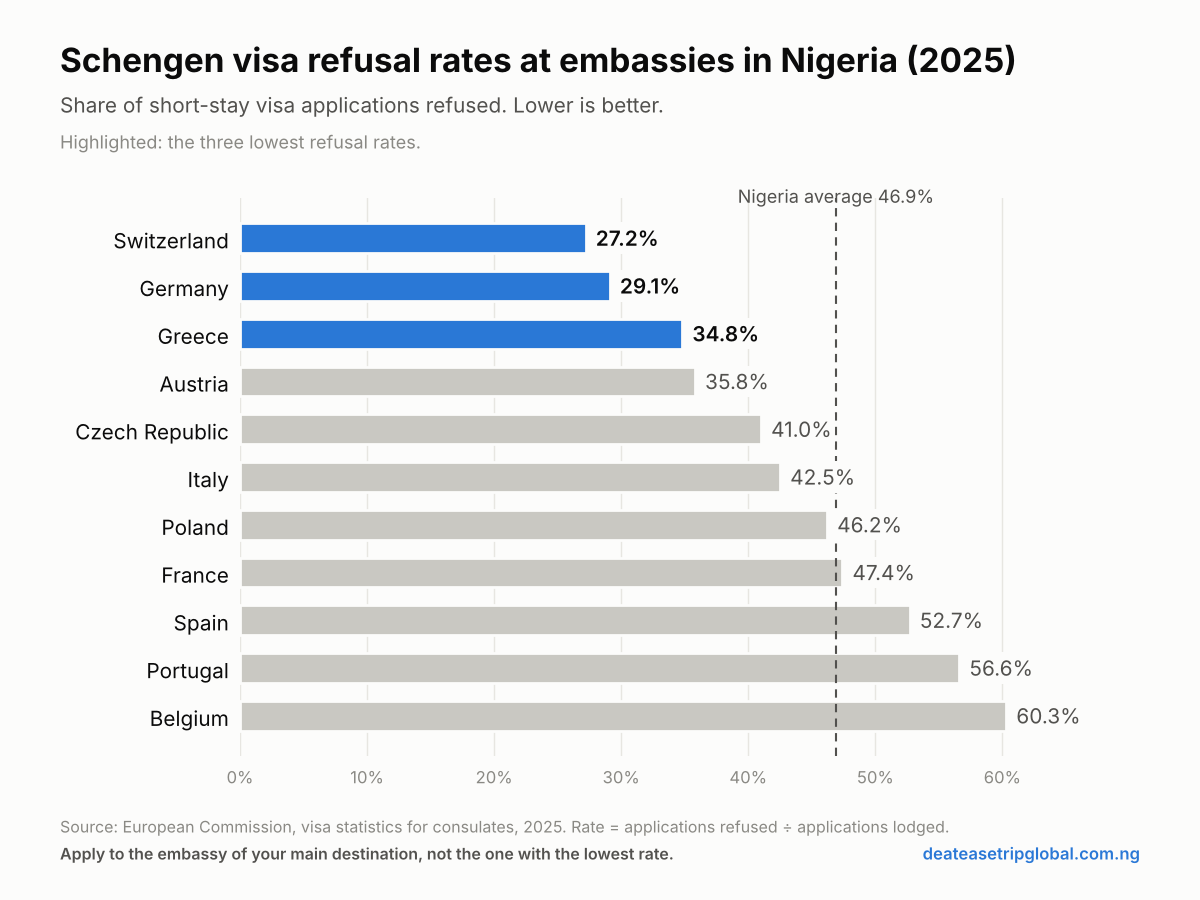
According to the European Commission’s official 2025 figures, the Schengen embassies in Nigeria that refused the smallest share of applications were Switzerland (27.2%), Germany (29.1%) and Greece (34.8%). The highest refusal rates were at Belgium (60.3%), Portugal (56.6%) and Spain (52.7%). Across all embassies in Nigeria, about 47 out of every 100 applications were refused.
But here’s the part most blogs leave out: you can’t simply apply to the embassy with the lowest refusal rate. Schengen rules say you must apply to the country you’re actually visiting. This guide shows you the real numbers, explains what they mean, and tells you how to give your own application the best chance.
What the official 2025 numbers say
Every year, the European Commission publishes visa statistics for every Schengen embassy and consulate in the world. The 2025 figures, released in May 2026, show that 113,359 short-stay Schengen visa applications were lodged in Nigeria. Of these, 53,196 were refused. That’s a refusal rate of about 46.9%.
To put that in context, the worldwide Schengen refusal rate in 2025 was 14.6%, according to the European Commission [https://home-affairs.ec.europa.eu/news/schengen-short-stay-visa-applications-rise-2025-remain-below-pre-pandemic-levels-2026-05-28_en]. Nigerian applicants are refused roughly three times as often as the global average.
The good news is that refusal rates vary a lot from one embassy to another. Here’s how the main Schengen embassies in Nigeria compare.
Schengen visa refusal rates at embassies in Nigeria (2025)
| Rank | Embassy (Schengen country) | Refusal rate 2025 | What this means |
|---|---|---|---|
| 1 | Switzerland | 27.2% | Lowest refusal rate in Nigeria |
| 2 | Germany | 29.1% | Low refusal rate, very high demand |
| 3 | Greece | 34.8% | Low rate, but few applications |
| 4 | Austria | 35.8% | Below the Nigeria average |
| 5 | Czech Republic | 41.0% | Below the Nigeria average |
| 6 | Italy | 42.5% | Below the Nigeria average |
| 7 | Poland | 46.2% | Close to the Nigeria average |
| 8 | France | 47.4% | Close to the Nigeria average |
| 9 | Spain | 52.7% | More than half refused |
| 10 | Portugal | 56.6% | More than half refused |
| 11 | Belgium | 60.3% | Highest refusal rate in Nigeria |
Source: European Commission, visa statistics for consulates, 2025. Rate calculated as applications refused divided by applications lodged.
A note on the figures: we calculated each rate as the number of applications refused divided by the number lodged at that embassy. The European Commission’s own spreadsheet uses a slightly different formula, so its published percentages can differ by one to three points. Either way, the ranking tells the same story. You can download the full spreadsheet from the European Commission’s visa statistics page [https://home-affairs.ec.europa.eu/policies/schengen/visa-policy/short-stay-visas-issued-schengen-countries_en].
Why Switzerland and Germany refuse fewer Nigerians
The statistics show what happened, not why. Embassies don’t publish the reasons behind their overall refusal rates. From our experience helping Nigerian travellers, a few factors usually play a part:
- Who applies. Some embassies receive more business travellers, conference delegates, and repeat visitors with strong travel histories. Those applicants are refused less often, which pulls the rate down.
- Purpose of travel. Trips with clear documents, such as an official invitation from a company or a conference registration, are easier to assess than open-ended tourist trips.
- Size of the sample. Greece’s low rate comes from only a few hundred applications. A small sample can swing a lot from year to year, so treat it with caution.
- Quality of applications. Embassies that receive many incomplete or inconsistent applications will refuse more, regardless of their policy.
The key lesson: a low refusal rate doesn’t mean that embassy is “soft”. It usually means the people applying there had strong, well-documented reasons to travel.
The rule you can’t ignore: apply to your main destination
This is where many Nigerians get into trouble. Under the EU Visa Code (Regulation 810/2009) [OUTBOUND LINK 3], you must apply to the right Schengen country. The rule works like this:
- If you’re visiting one Schengen country, apply to that country’s embassy.
- If you’re visiting several countries, apply to the country where you’ll spend the most time, or where the main purpose of your trip is.
- If you’ll spend equal time in each country and no main purpose stands out, apply to the country where you’ll first enter the Schengen area.
So if your trip is mainly to Paris, you must apply to France, even though Switzerland refuses fewer people. If you apply to Switzerland for a trip that’s really about France, the embassy can refuse you for applying to the wrong country. Even if you get the visa, you may be questioned at the border, and it can count against you on future applications.
The honest answer to “which Schengen country is easiest?” is this: the easiest one is the country you’re genuinely visiting, with a complete, consistent and honest application.
When you do have a real choice
Sometimes your plans are flexible. You might want a first European holiday and haven’t decided where to go, or your company could send you to a trade fair in more than one country. In that case, the refusal rates can help you plan:
- Make your main destination the country you most want to spend time in, then build your itinerary, hotel bookings and flights around it.
- Your documents must match. If most of your hotel nights are in Germany, your application should be to Germany.
- Don’t change your plans after the visa is issued to spend most of your time somewhere else. That kind of pattern leads to refusals next time.
Why Nigerian Schengen applications get refused
Whichever embassy you apply to, most refusals come down to the same problems. These are the ones we see most often:
- Weak proof of funds. Bank statements with sudden large deposits shortly before the application, or balances that don’t match your stated income.
- Unclear purpose of travel. No clear itinerary, or an itinerary that doesn’t match your hotel bookings and leave dates.
- Weak ties to Nigeria. No clear evidence of a job, business, property, studies or family that you’ll return to.
- Inconsistent documents. Different salary figures on your employment letter and bank statement, or different dates on your form and bookings.
- Applying to the wrong country, as explained above.
- False or doubtful documents. These lead to refusal and can damage your future applications to every Schengen country.
For more detail, read our guides on common reasons visa applications are rejected [Schengen visa Nigeria 2026] and visa application mistakes to avoid [https://deateasetripglobal.com.ng/common-visa-application-mistakes/].
Schengen visa basics for Nigerians in 2026
| Visa type | Short-stay (type C) Schengen visa |
| Maximum stay | Up to 90 days in any 180-day period |
| Visa fee | €90 for adults; €45 for children aged 6 to 11; free for children under 6. Usually paid in naira at the day’s exchange rate, plus the application centre’s service fee. |
| When to apply | No earlier than 6 months and no later than 15 days before your trip |
| Decision time | Usually within 15 calendar days; can be extended to 45 days in some cases |
| Travel insurance | Required, with at least €30,000 medical cover valid in all Schengen countries |
| Where to apply | The embassy of your main destination, usually through its official visa application centre in Lagos or Abuja |
Fees and procedures can change. Always confirm the current details on the official website of the embassy you’re applying to before you pay. For a full document checklist, see our Schengen visa requirements guide for Nigerians [https://deateasetripglobal.com.ng/schengen-visa-requirements-for-nigerians/].
How to give your Schengen application the best chance
- Decide your main destination first, and make every document point to it.
- Prepare 3 to 6 months of genuine bank statements that show steady income, not last-minute deposits.
- Show strong ties to Nigeria: an employment letter with approved leave, CAC documents for business owners, school letters for students, or evidence of property and family.
- Book refundable flights and hotels. Many embassies accept reservations rather than paid tickets. Our flight booking [https://deateasetripglobal.com.ng/schengen-visa-requirements-for-nigerians/] and hotel reservation [https://deateasetripglobal.com.ng/hotel-reservation-services/] services can help with this.
- Write a short, honest cover letter explaining who you are, why you’re travelling, who is paying, and when you’ll return.
- Check that everything matches: names, dates, amounts and addresses across your form, bank statements, letters and bookings.
- Book your appointment early. Slots in Lagos and Abuja can be hard to get at busy times. Only book through the embassy’s official visa centre, and never pay anyone who claims they can “buy” you a slot.
- Declare any previous refusals. Hiding a past refusal is far more damaging than the refusal itself.
How De At Ease Global Services can help
We help Nigerians prepare Schengen visa applications that are complete, consistent and honest. We can help you:
- Choose the correct embassy for your trip
- Review your bank statements, employment letter and supporting documents before you submit
- Prepare a clear itinerary and cover letter
- Arrange flight and hotel reservations that match your application
No agent can guarantee a Schengen visa. Only the embassy decides. What we can do is help you avoid the mistakes that cause most refusals.
Planning a trip to Europe? See our Schengen visa assistance service [https://deateasetripglobal.com.ng/schengen-visa-assistance/] or chat with us on WhatsApp [https://wa.me/2348124020028] for a document review.
Frequently asked questions
Which Schengen country is easiest for Nigerians to get a visa from?
In 2025 figures, Switzerland (27.2% refused) and Germany (29.1% refused) had the lowest refusal rates among Schengen embassies in Nigeria. However, you must apply to the country that is your main destination, so the “easiest” embassy is only an option if you’re genuinely travelling there.
What is the Schengen visa refusal rate for Nigerians?
About 46.9% in 2025. Of 113,359 short-stay applications lodged in Nigeria, 53,196 were refused, according to European Commission statistics. The worldwide average was 14.6%.
Can I apply to Switzerland or Germany if I’m mainly visiting another country?
No. Under the EU Visa Code, you must apply to the country where you’ll spend the most time or where the main purpose of your trip is. Applying to the wrong country can lead to a refusal and can cause problems at the border or on future applications.
Which Schengen embassy refuses the most Nigerians?
In 2025, Belgium had the highest refusal rate among Schengen embassies in Nigeria, at about 60.3%, followed by Portugal (56.6%) and Spain (52.7%).
How much is the Schengen visa fee in Nigeria?
The standard Schengen visa fee is €90 for adults and €45 for children aged 6 to 11. Children under 6 don’t pay. You usually pay the naira equivalent, plus a service fee to the visa application centre. Check the embassy’s website for the current amount.
Does a Schengen visa refusal affect future applications?
A previous refusal is recorded, and embassies can see it, but it doesn’t automatically mean you’ll be refused again. Fix the reasons given in your refusal letter and always declare the previous refusal on your new application.
Can a travel agent guarantee my Schengen visa?
No. Only the embassy decides. Be careful of anyone who promises guaranteed approval or offers to sell appointment slots.
Sources: European Commission, Short-stay visas issued by Schengen countries (2025 statistics for consulates); European Commission news, 28 May 2026; European Commission, Visa policy; EU Visa Code, Regulation (EC) No 810/2009.
De At Ease Global Services is an independent travel consultancy and is not affiliated with any embassy or visa application centre. Visa rules and fees can change. Always confirm with official sources before you apply.
Related guides: Which European Country Is Easiest for Nigerians to Get a Visa? A Practical Guide and Schengen Visa for Nigerians.