

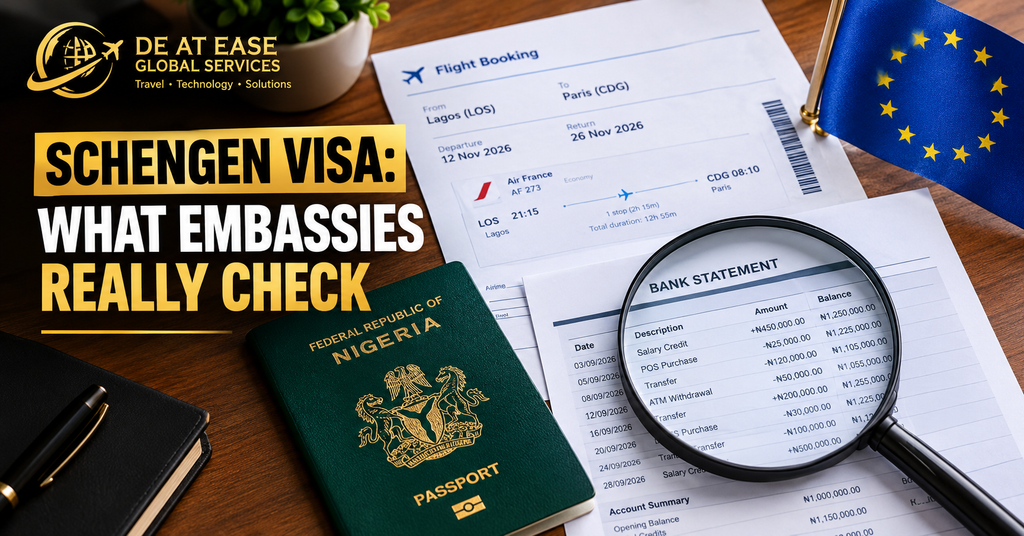
Schengen Visa for Nigerians in 2026: What European Embassies Actually Check Before They Approve You
Two Nigerians submit Schengen visa applications on the same day. Both have money, both have hotel bookings, both have flight reservations. One is approved in two weeks. The other gets a refusal letter with one ticked box. What made the difference? Usually it isn’t luck. It is what the embassy officer saw, or didn’t see, in the file. In this guide, we explain in simple English exactly what European embassies check, and how to make your application easy to approve.
1. First, how a Schengen officer thinks
A Schengen visa lets you visit 29 European countries, such as France, Germany, Italy, Spain and the Netherlands, for up to 90 days in any 180-day period. The rules come from the EU Visa Code, which you can read about on the European Commission visa policy page.
The officer has one main question in mind: “Will this person come to Europe for the reason they gave, and go back home on time?” Every document you submit should answer that question with a clear yes. Officers often have only a few minutes for each file, so a clean, logical application wins.
2. The five things embassies actually check
1. Your purpose of travel. Is your reason clear and believable? Tourism, business, a conference, a family visit or medical treatment must be backed with matching documents, such as an invitation letter, a conference registration or a hotel booking. Your itinerary, dates and budget must all tell the same story.
2. Your money. This is where most Nigerian applications fail. Officers check:
- Bank statements for 3 to 6 months, stamped and signed by your bank.
- Regular income, like salary credits or steady business inflows, not one big lump sum.
- A balance that matches your trip. A ten-day trip to Paris needs more than a small balance, but a sudden ₦15 million deposit a week before applying looks like “funds parking”, and officers recognise it.
3. Your ties to Nigeria. Officers want proof that you have strong reasons to come back:
- A job letter showing your role, salary and approved leave.
- CAC documents and tax records if you own a business.
- Property documents, a spouse or children at home, or ongoing studies.
4. Your travel history. Previous visas to the UK, US, Canada, Dubai or other Schengen countries, used correctly, are a strong plus. A clean record of returning on time builds trust. If this is your first trip abroad, it is not a problem, but your other documents must be extra strong.
5. Your honesty. Fake bank statements, fake job letters and fake hotel bookings are easy to check. If discovered, you may be refused and flagged in the Schengen system, which can affect future applications to every Schengen country.
Not sure if your documents are strong enough? Send us a message on WhatsApp (https://wa.me/2348124020028) for a Quick Consultation (₦7,000). We will tell you honestly what an officer will see.
3. Required documents checklist
Most Schengen embassies in Nigeria ask for:
- A valid international passport, issued within the last 10 years, valid for at least 3 months after you leave Europe, with at least two blank pages.
- A completed and signed application form.
- Recent passport photographs that meet the embassy’s size rules.
- Travel medical insurance covering at least €30,000 for the whole Schengen area.
- A flight reservation and hotel bookings, or an invitation letter if staying with someone.
- Bank statements, a job letter or business documents.
- A cover letter explaining your trip.
Most countries use visa centres such as VFS Global or TLScontact to collect applications and biometrics in Lagos and Abuja.
4. The top refusal reasons for Nigerians
When a Schengen visa is refused, the letter usually has a ticked box. The most common ones we see are:
- “Justification for the purpose and conditions of the intended stay was not provided.” Your story or documents did not match.
- “You have not provided proof of sufficient means of subsistence.” Your money was too low, too new, or not clearly yours.
- “There are reasonable doubts as to your intention to leave the territory before the expiry of the visa.” Your ties to Nigeria looked weak.
- “The information submitted was not reliable.” A document looked false or did not add up.
The good news is that each of these can be fixed before you reapply.
Refused before? Book a Refusal Review (₦15,000). We go through your refusal letter, line by line, and plan a stronger application.
5. Fees, timelines and the new border system
The standard Schengen visa fee is €90 for adults and €45 for children aged 6 to 12, plus the visa centre’s service charge. You can apply up to six months before your trip, and no later than 15 days before. A decision usually comes within 15 days, but it can take up to 45 days in busy periods, so apply early, especially before summer and Christmas.
Also note that Europe now uses the Entry/Exit System (EES), which records your fingerprints and photo at the border instead of stamping your passport. It makes overstays easy to detect, so always leave on time. You can learn more on the EU Entry/Exit System page.
6. Five tips that make approval easier
- Apply to the right country. Apply to the country where you will spend the most days, or your first entry if the days are equal.
- Write a clear cover letter. In one page, explain who you are, why you are going, who is paying and when you will return.
- Keep your story consistent. Dates on your flight, hotel, leave letter and insurance must match.
- Build your account over time. Steady inflows over months look far better than one large deposit.
- Start with an easier trip. Some travellers build history with Dubai or the UK before a first Schengen trip.
If Europe is not your only option, read our guides on applying for a UK visa from Nigeria and the best countries Nigerians are relocating to in 2026. US visitor visas are currently suspended for Nigerians, as explained in can Nigerians still get a US visa in 2026, and students should also read about UK universities withdrawing offers from Nigerian students. For all the latest changes, see our monthly visa updates for Nigerians.
Frequently asked questions
How much money do I need in my account for a Schengen visa from Nigeria? There is no single amount for all countries. Each country sets its own daily minimum, and your balance must comfortably cover your trip. Steady income matters as much as the balance.
How many months of bank statements do I need? Usually 3 to 6 months, stamped and signed by your bank.
What is the Schengen visa fee for Nigerians? €90 for adults and €45 for children aged 6 to 12, plus the visa centre’s service charge.
Can I get a Schengen visa with no travel history? Yes, but your purpose, money and ties to Nigeria must be very strong and clearly documented.
How long does a Schengen visa take in Nigeria? Usually about 15 days, but it can take up to 45 days, so apply early.
Can I reapply after a Schengen refusal? Yes. Fix the reasons on your refusal letter first. Some countries also allow an appeal.
Get your Schengen file checked before you submit
A refusal costs you the visa fee, the service charge and months of waiting, and it stays on your record. A short review before you submit can save all of that.
- Quick Consultation (₦7,000): Find out if your Schengen plan is ready.
- Document Review (₦10,000): We check your bank statements, job letter, cover letter and bookings before you apply.
- Refusal Review (₦15,000): If you were refused, we plan a stronger application.
👉 Chat with us on WhatsApp now: https://wa.me/2348124020028, or book a consultation here: https://calendar.app.google/5ABo2qdXMHTAt9yh8.
Disclaimer: Schengen visa rules and fees can change. This article is general information, not legal advice. Always confirm with the embassy or visa centre of the country you are applying to.
Related guides: Schengen Visa Requirements for Nigerians (2026) and Easiest Schengen Visa Country for Nigerians.