

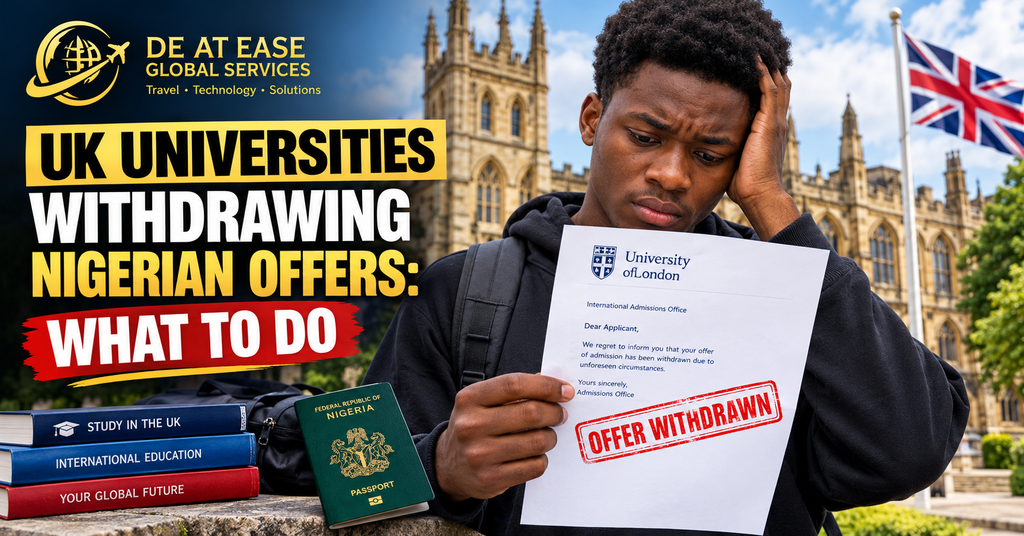
Why UK Universities Are Withdrawing Offers from Nigerian Students in 2026, and How to Protect Your Admission
Imagine getting your UK admission letter, paying your deposit, and telling your family you are finally going, only to receive an email weeks later saying your offer has been withdrawn. In 2026, this is happening to more Nigerian students than ever before. The good news is that it is not random. Once you understand why universities are doing it, you can take clear steps to protect your place.
1. What is happening?
In October 2026, several Nigerian news outlets reported that UK universities are withdrawing admission offers from international applicants, especially Nigerians and Pakistanis (Vanguard).
The numbers are striking. According to a Financial Times analysis of Home Office data, republished by The PUNCH on 10 October, 22.7% of UK study visa applications from Nigerians were withdrawn in the first half of 2026. In the same period of 2025, it was only 4.5% (Advocate). That means withdrawals have grown about five times in one year.
2. Why are UK universities doing this?
The main reason is fear of losing their licence to recruit international students.
Every UK university that sponsors student visas must meet strict Home Office compliance rules. One of them is about visa refusal rates. If too many of a university’s sponsored students are refused visas, the university can be penalised, and in serious cases it can lose the right to recruit overseas students at all (Nairametrics).
So when universities see rising refusals from a country, many of them become very careful. Instead of risking a refusal, they withdraw the offer or the CAS (Confirmation of Acceptance for Studies) before the student applies for the visa. In plain words: they would rather cancel your admission than see you refused.
3. Who is most at risk?
From what we see with clients and in the reports, these applicants face the most pressure:
- Weak or unclear proof of funds, especially money that appears suddenly in an account or comes from a sponsor with no clear link.
- Big gaps in study or work history that are not explained.
- Course choices that do not match your background, for example a banker suddenly choosing a nursing top-up with no reason.
- Students who cannot clearly explain their plans in a university or Home Office credibility interview.
- Late applicants who rush documents close to the deadline.
If you are in one of these groups, it does not mean you will be rejected. It means you must prepare more carefully.
Worried about your UK offer? Send us a message on WhatsApp (https://wa.me/2348124020028) for a Quick Consultation (₦7,000). We will tell you honestly where your application is weak.
4. Seven steps to protect your UK admission
- Get your funds right early. Your money must meet the Home Office amount for tuition balance plus living costs, and it must stay in the account for at least 28 consecutive days. Check the current figures on the official GOV.UK Student visa page.
- Show where the money came from. Keep salary slips, business records, sale agreements or sponsor letters. Sudden large deposits with no story behind them are a red flag.
- Choose a course that makes sense. Your course should connect to your past study or work and your future career. Write down why you chose it, in your own words.
- Prepare for the credibility interview. Know your course modules, your university, its city, your fees and your plan after graduation. Practise answering out loud.
- Be honest in every form. Never use fake documents or agents who “arrange” bank statements. One false document can lead to a ban of up to 10 years.
- Reply to your university fast. If they ask for documents or an interview, respond quickly and completely. Delays look like risk.
- Apply on time. Don’t leave your visa application until the last weeks before your course starts.
For the full application process, read our guide on how to apply for a UK visa from Nigeria.
5. My offer was already withdrawn. What now?
First, stay calm and ask the university for the reason in writing. Then:
- Ask about your deposit. Many universities refund deposits when they withdraw an offer, but check their terms.
- Ask if you can reapply for a later intake, such as January or September next year, once your documents are stronger.
- Try another UK university with a better fit for your profile. Some universities are less strict than others.
- Look at other countries. Canada, Ireland and some European countries are still welcoming Nigerian students. See our Canada visa fees guide and the best countries Nigerians are relocating to in 2026.
If you were also thinking about America, please read can Nigerians still get a US visa in 2026 first, because US student visas are currently suspended for Nigerians.
Refused or withdrawn before? Book a Refusal Review (₦15,000). We go through your letter and plan a stronger next application.
6. Is the UK still a good option for Nigerians?
Yes, for well-prepared students. Thousands of Nigerians still study in the UK every year, and the Graduate route still allows students to stay and work after they finish. What has changed is that universities now check you much more carefully before they let you apply for a visa. Treat your application like a job interview: be prepared, honest and clear.
For the latest news on the UK and other countries, check our monthly visa updates for Nigerians.
Frequently asked questions
Why are UK universities withdrawing offers from Nigerian students? Mainly because rising visa refusals could put their licence to sponsor international students at risk, so they cancel offers they see as high risk.
How many Nigerian UK study visa applications were withdrawn in 2026? About 22.7% in the first half of 2026, up from 4.5% in the same period of 2025, according to an FT analysis of Home Office data.
Can I get my deposit back if my offer is withdrawn? Often yes, but it depends on the university’s refund policy. Ask for it in writing.
Does a withdrawn offer affect my future UK visa? A withdrawn offer is not the same as a visa refusal. But if you applied for a visa and were refused, you must declare that in future applications.
How long must my money stay in my account for a UK student visa? At least 28 consecutive days, ending no more than 31 days before you apply.
Can I still study in the UK in 2027? Yes. Prepare your funds, documents and interview early, and apply on time.
Talk to us before you pay any more fees
Many Nigerian families are losing deposits, agent fees and time because of avoidable mistakes. A short consultation can show you exactly what to fix before you apply.
- Quick Consultation (₦7,000): Find out if your UK plan is strong enough.
- Document Review (₦10,000): We check your bank statements, sponsor letters and CAS documents before you submit.
- Refusal Review (₦15,000): If your offer or visa was refused, we plan your next move.
👉 Chat with us on WhatsApp now: https://wa.me/2348124020028, or book a consultation here: https://calendar.app.google/5ABo2qdXMHTAt9yh8.
Disclaimer: UK student visa rules change often. This article is general information, not legal advice. Always confirm with GOV.UK and your university before you apply.
Related guides: UK Visitor Visa Requirements for Nigerians and UK Visa Refusal for Nigerians (2026).