

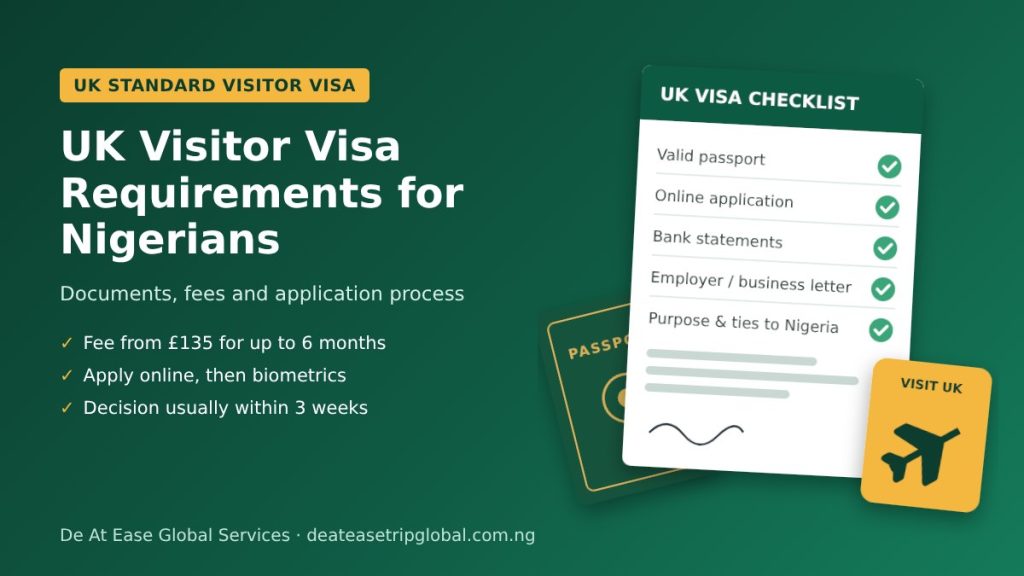
Quick answer: UK visitor visa requirements for Nigerians centre on one question: can you show you are a genuine visitor? Nigerians need a visa to visit the UK. The Standard Visitor visa costs £135 for up to six months, and you can apply up to three months before you travel. After applying online, you give your fingerprints and photo at a UK visa application centre, and most applicants get a decision within three weeks. To succeed, you must show that you will leave at the end of your visit, can support yourself and can pay for your return journey.
This guide brings together the official requirements from GOV.UK and explains them in plain language for Nigerian applicants. Every applicant’s circumstances are different, so the documents that best support your application will depend on your job, finances, purpose of travel and who is paying.
What is the UK Standard Visitor visa?
The Standard Visitor visa is the main visa for short trips to the UK. It covers tourism, family visits, certain business activities and some other short-term purposes. You can usually stay for up to six months on each visit.
Long-term visit visas are also available, valid for two, five or ten years. They allow repeated visits, but each stay is still limited to a maximum of six months.
UK visitor visa requirements for Nigerians: who can apply?
According to GOV.UK, you must be able to show that:
- you will leave the UK at the end of your visit
- you can support yourself and any dependants during your trip, or someone else is funding you
- you can pay for your return or onward journey, or someone else is funding it
- you will not live in the UK for extended periods through frequent or successive visits, or make the UK your main home
Your passport should be valid for the whole of your stay.
What can Nigerians do on a UK visitor visa?
Permitted activities include:
- tourism and holidays
- visiting family and friends
- certain business activities, such as attending meetings, conferences or interviews
- certain paid engagements as an expert in your field
- volunteering for up to 30 days with a registered charity
- a recreational course of up to 30 days
- some study, placements or exams (extra conditions apply)
- private medical treatment
- school exchange programmes
- transit through the UK
What you cannot do on a UK visitor visa
You must not:
- do paid or unpaid work for a UK company or work as self-employed (except permitted paid engagements)
- claim public funds (benefits)
- live in the UK for long periods through frequent or successive visits
- get married or register a civil partnership (you need a Marriage Visitor visa for this)
Breaking these rules can seriously affect future applications.
UK visitor visa fees for Nigerians
These are the fees published on GOV.UK (last updated 13 October 2026):
| Visa type | Fee | Maximum stay per visit |
|---|---|---|
| Standard Visitor (up to 6 months) | £135 | 6 months |
| Long-term visit visa – 2 years | £506 | 6 months |
| Long-term visit visa – 5 years | £903 | 6 months |
| Long-term visit visa – 10 years | £1,128 | 6 months |
| Visit for private medical treatment | £234 | 11 months |
| Academic visitor | £234 | 12 months |
You pay the fee online as part of your application. Fees change from time to time, so always check GOV.UK before paying. Optional services, such as a faster decision, cost extra where available.
UK visa documents checklist for Nigerian applicants
The UK’s guide to supporting documents says its list of suggested documents is not exhaustive. Submitting these documents does not guarantee approval, and not all of them will apply to you. Use this checklist as a starting point.
Mandatory
- valid international passport (valid for your whole stay)
- completed online application and payment confirmation
- biometric appointment confirmation
Financial evidence
- your bank statements showing the origin of your funds
- payslips or proof of income
- sponsor documents if someone else is paying
Purpose of visit
- invitation letter from family or friends in the UK, with their status and address
- conference registration or business invitation
- travel itinerary and accommodation details
Ties to Nigeria
- employer letter confirming your role, salary, length of employment and approved leave
- business registration documents
- school or university letter confirming enrolment and leave of absence
- marriage certificate and children’s birth certificates
- property documents
Travel history (optional)
- previous passports showing travel to other countries
Translations
Documents not in English or Welsh must come with a full translation. GOV.UK says it should include the translator’s confirmation of accuracy, the date, their full name, signature and contact details.
Bank statement requirements
There is no fixed minimum balance for a UK visitor visa. GOV.UK says your financial documents should clearly show that you have access to the funds, and gives “bank statements which detail the origin of the funds held” as an example. Statements issued more than a year before your application are treated as weak evidence.
Officers look for steady income, normal spending and explained deposits. For a full explanation, read our guide on UK visitor visa bank statements for Nigerians.
Employment and business documents
Employed applicants should provide a letter from their employer on company headed paper. GOV.UK suggests that it confirm your role, salary and length of employment. Approved leave dates are also useful. Recent payslips should match the salary credits on your statement.
Business owners should show that the business is real, active and benefits them personally:
- CAC certificate and status report
- business bank statements
- tax clearance certificate
- personal bank statement showing how you pay yourself
Requirements for self-employed applicants
GOV.UK suggests business registration documents or recent invoices that confirm ongoing self-employment. Freelancers and traders should also provide contracts, client invoices that match bank credits and a short letter explaining their work. For a full breakdown of business evidence, read our guide to the UK visitor visa for self-employed Nigerians.
Requirements for students and unemployed applicants
Students can provide a letter from their school or university confirming enrolment and leave of absence. A parent or guardian usually sponsors the trip.
Unemployed applicants can still apply. You will need to show how the trip will be funded, usually through savings or a sponsor, and what ties will bring you back to Nigeria. Read our guide on applying for a visa without a job.
Sponsors must show their relationship to you and that they have enough funds to support you. If your sponsor lives in the UK, include evidence of their immigration status.
How to apply for a UK visitor visa from Nigeria
Here is the process in brief. For a detailed walkthrough, see our guide on how to apply for a UK visa from Nigeria.
- Check your eligibility and decide which visa length suits you.
- Apply online through the official GOV.UK application. The earliest you can apply is three months before you travel.
- Pay the visa fee online.
- Book your biometrics appointment at a visa application centre.
- Upload or bring your supporting documents, as instructed.
- Attend your appointment and give your fingerprints and photo.
- Wait for a decision, usually within three weeks.
Answer every question honestly. Your answers must match your documents.
How to book biometrics
After submitting your online application, you will be directed to book an appointment with the UK visa application centre provider. GOV.UK’s visa application centre finder links Nigerian applicants to VFS Global. Check the VFS website for current centre locations, appointment availability and any optional paid services.
In some cases, UKVI may tell you that you can prove your identity using the UK Immigration: ID Check app instead. Only use the app if you are told you can.
What happens at the visa application centre?
At your appointment you will:
- show your passport to confirm your identity
- have your fingerprints and photograph taken (your biometric information)
- submit or confirm your supporting documents, depending on the centre’s instructions
Arrive on time with your passport and appointment confirmation. Follow the centre’s rules on what you can bring inside.
UK visa processing time in Nigeria
GOV.UK’s processing times guidance states that Standard Visitor applications are usually decided within three weeks. This counts UK working days and starts after you attend your biometrics appointment or verify your identity through the app. Faster decision services may be available for an extra fee. Apply early, especially before busy periods such as summer and Christmas.
Common reasons for UK visitor visa refusal
Common reasons include:
- not showing that you will leave the UK at the end of your visit
- unclear or unexplained source of funds
- financial circumstances that do not match your declared income
- an unconvincing purpose of travel
- inconsistencies between your form and documents
- previous immigration breaches
- false documents or deception, which can lead to a 10-year ban under the Immigration Rules
What to do after a refusal
Read your refusal letter carefully, as it explains the reasons. Most visitor visa refusals have no right of appeal, but you can submit a new application that properly addresses the concerns. Do not reapply with the same documents. Read our detailed guide on UK visa refusal for Nigerians.
Practical Nigerian examples
These are hypothetical illustrations, not official rules.
Olumide, 38, IT manager, Lagos – visiting his sister in Manchester. He submits his employer letter with approved leave, six months of salary statements, his sister’s invitation letter and a copy of her British passport.
Hauwa, 42, textile business owner, Kano – attending a trade show in London. She provides her CAC documents, business and personal statements, tax clearance and the trade show registration.
Tobi, 20, university student, Ibadan – summer holiday with relatives. His mother sponsors him. He submits his enrolment letter, his mother’s employer letter and statements, and his birth certificate.
How De At Ease Global Services can help
De At Ease Global Services helps Nigerian travellers prepare for UK visit applications. We can review your documents against official guidance, explain what each part of the application asks for and help you avoid common mistakes. We can also arrange flight bookings and hotel reservations for your itinerary. We do not make visa decisions, and no agent can guarantee approval, but careful preparation gives you the best chance of a fair outcome.
Related guides: UK Universities Withdrawing Offers from Nigerian Students.
Frequently asked questions
How much is a UK visitor visa for Nigerians?
A Standard Visitor visa for up to six months costs £135. Long-term visit visas cost £506 (2 years), £903 (5 years) and £1,128 (10 years), according to GOV.UK.
How long does a UK visitor visa take in Nigeria?
GOV.UK says most applicants get a decision within three weeks of their biometrics appointment.
How much money do I need in my account for a UK visitor visa?
There is no fixed amount. You must show that you can fund your trip and that your money comes from a genuine source. See our guide on how much money you should have in your bank account.
Can I apply for a UK visitor visa without travel history?
Yes. Travel history is helpful but not required. Read our guide on getting a visa without travel history.
Where do Nigerians do UK visa biometrics?
At a UK visa application centre run by VFS Global. Check the VFS website for current locations.
How early can I apply?
Up to three months before your travel date.
Conclusion
The UK visitor visa requirements for Nigerians are clear on paper: show a genuine purpose, adequate funds and a firm intention to return. In practice, success depends on how well your documents support your story. Check the latest guidance on GOV.UK, prepare honest and consistent evidence, and apply well ahead of your travel date.
Ready to apply? Book a consultation with De At Ease Global Services, explore our UK visa assistance service, or read our FAQ.
De At Ease Global Services is an independent travel consultancy and is not affiliated with UK Visas and Immigration, VFS Global or any government. Requirements and fees change; always confirm with GOV.UK before applying.