

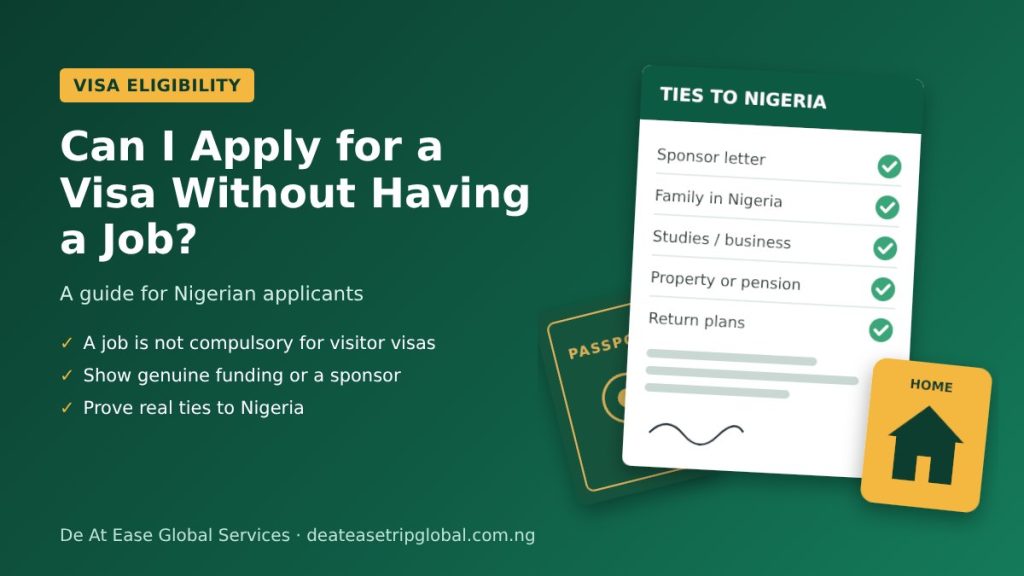
Quick answer: Yes. You can apply for a visa without a job. Many Nigerian applicants are surprised to learn that none of the major destinations (the UK, Canada, the United States, the Schengen countries, Australia or China) makes employment a compulsory requirement for a visitor visa. What officers need to see is that your trip is affordable, that the money comes from a genuine source and that you have good reasons to return to Nigeria. A job is one way to show this, but it is not the only way.
Some people assume a visa is impossible without an employment letter. As a result, some are tempted to buy fake employment letters from agents, which is the fastest route to refusal and possible bans. This visa without a job Nigeria guide explains how the process actually works, what officers look for, and how to present your real circumstances honestly.
Visa without a job Nigeria: is a job compulsory for a visitor visa?
No. Here is what official sources say:
| Destination | What the official guidance says |
|---|---|
| United Kingdom | You must show you can support yourself, will leave at the end of your visit and can pay for your return journey. An employer letter is one example of evidence, not a requirement (GOV.UK). |
| Canada | You must convince an officer that you have ties “such as a job, home, financial assets or family” and will leave Canada (IRCC eligibility). |
| United States | Under section 214(b), applicants must show strong ties to their home country. The State Department lists your job, your home and your relationships with family and friends as examples (travel.state.gov). |
| Schengen | Embassies ask for proof of social and economic ties. The Danish embassy in Nigeria, for example, lists marriage and birth certificates, employment contracts, and leave letters from an employer or school. |
| Australia | Visitors must have enough money for their stay and show a genuine temporary visit (Home Affairs). |
| China | The Chinese Consulate in Lagos does not list employment as a requirement. Nigerian tourists are asked to travel in a group, and business visas require six months of statements from the applicant or company. |
The key idea across all six destinations is ties: the things that will bring you back to Nigeria.
What immigration officers consider when you have no job
Officers look at your whole situation. When there is no employment, they focus more closely on:
- Who is paying for the trip, and whether that person can afford it.
- Why you are travelling, and whether the purpose makes sense for someone in your position.
- What you are doing in Nigeria now: studying, running a business, caring for family, searching for work or retired.
- What will bring you back: family, property, studies, a business, a job offer or ongoing commitments.
- Your travel history, especially previous trips where you returned on time.
A gap in employment is not suspicious on its own. An unexplained gap, combined with an expensive trip and no clear source of funds, is.
How unemployed applicants can show financial support
If you have no salary, you need to show where the money for your trip is coming from. Common legitimate sources include:
- savings from previous work
- rental income from property
- a pension
- dividends or investment income
- a sponsor, such as a parent, spouse or relative
Your bank statement should show this money clearly. Read our guides on how much money you should have in your bank account and how to prepare a bank statement for a visa.
Can parents, spouses, relatives or other sponsors support your application?
Yes. Sponsorship is common and acceptable. The UK guidance says you should show your relationship with the sponsor and that the sponsor has enough funds to support you.
A sponsor could be:
- a parent paying for an adult child’s trip
- a spouse supporting a husband or wife who is not working
- a relative or friend abroad who is hosting you
- an organisation inviting you to a conference or event
The sponsor’s finances are assessed in the same way as yours would be. They should be steady, explained and able to cover the trip without strain.
Sponsor document checklist
- a signed sponsorship letter stating what they will pay for and for how long
- the sponsor’s bank statements (often six months)
- the sponsor’s proof of income, such as an employment letter or business documents
- proof of relationship, such as a birth or marriage certificate
- a copy of the sponsor’s passport or ID
- if the sponsor lives abroad: proof of their immigration status and address (for example, an invitation letter for Canada)
Documents unemployed applicants may provide
There is no official “unemployed applicant” checklist. Each embassy sets its own list. Depending on your situation, useful documents include:
- your own bank statement, even if the balance is modest
- sponsor documents (see above)
- marriage certificate and children’s birth certificates
- property documents, such as a certificate of occupancy or tenancy agreement
- evidence of ongoing studies, training or a job offer starting after your return
- a short, honest cover letter explaining your current situation and the purpose of your trip
- a travel itinerary and accommodation details
Always follow the checklist issued by the embassy or visa application centre for your destination.
Visa applications for self-employed people
Self-employed people are not unemployed. You simply need different evidence from a salary earner. The UK guidance suggests “business registration documents or recent invoices” that confirm ongoing self-employment.
Self-employed checklist
- business registration (CAC certificate or business name registration)
- business and personal bank statements
- invoices, receipts or contracts
- tax clearance certificate
- a short letter describing your business and who will run it while you travel
Visa applications for freelancers and remote workers
Freelancers, such as writers, developers, designers and virtual assistants, often get paid by foreign clients. Officers may not understand your work unless you explain it. Provide:
- contracts or ongoing agreements with clients
- invoices that match payments on your statement
- payout records from platforms you use
- a domiciliary account statement if you are paid in foreign currency
- a brief letter describing your work, clients and typical monthly income
Be careful about one point: a visitor visa does not allow you to work for a local employer in the country you visit. If you plan to keep serving your Nigerian or international clients while abroad, check the destination’s official rules on remote work first.
Visa applications for students
Students are not expected to have jobs. For a visitor visa, the UK guidance mentions a letter from your education provider confirming your enrolment and leave of absence. Students usually rely on a parent or guardian as a sponsor.
Student visitor checklist
- letter from your school or university confirming enrolment and approved break
- student ID card
- parent’s or guardian’s sponsorship letter and bank statements
- proof of relationship (birth certificate)
For study visas, the rules are different and usually include published funding amounts. See our student visa service.
Visa applications for retired people
Retirees have time to travel and often have strong ties to Nigeria, such as property, family and pensions. Useful documents include:
- pension statements or a letter from your pension fund administrator
- bank statements showing pension payments
- property documents or rental income evidence
- retirement letter or evidence of previous employment
- evidence of family in Nigeria
How business owners can show their income
Business owners should prove that the business is real, active and benefits them personally:
- CAC certificate and status report showing your ownership
- business bank statements
- audited or management accounts
- tax clearance certificate
- personal bank statement showing regular transfers from the business
Company funds belong to the business, so do not rely on a business account alone.
How to explain unemployment or career gaps
Be honest and brief. Officers do not need a long story, but they do need to understand your situation. A good cover letter explains:
- when you stopped working and why (for example, redundancy, contract ended, further studies, caring for a child)
- what you are doing now (job searching, training, running a small business)
- how the trip is being funded
- why you will return (family, a job interview, property, an ongoing course)
Support each statement with documents where possible, such as a redundancy letter, training enrolment or interview invitation.
Practical Nigerian examples
These are hypothetical illustrations, not official rules.
Amaka, 34, Enugu – stay-at-home mother visiting her sister in the UK. Her husband, an accountant, sponsors her trip. She submits his employment letter, six months of his bank statements, their marriage certificate and their children’s birth certificates. Her children remain in Nigeria with their father.
Tunde, 27, Lagos – recently made redundant, attending a family wedding in Canada. He submits his redundancy letter, his own savings statement, an invitation letter from his cousin and evidence of an ongoing professional certification course in Lagos.
Mrs Okafor, 66, Owerri – retired teacher visiting her son in the US. She provides her pension statements, her house documents and evidence of her other children in Nigeria. At the interview, she explains her plans simply and honestly.
Bisi, 29, Ibadan – freelance graphic designer travelling to France. She submits her business name registration, client contracts, invoices matching her domiciliary account credits and her personal bank statements.
Common mistakes applicants without jobs should avoid
- Buying a fake employment letter. Embassies verify employers. Using false documents can lead to refusal and long bans. Under UK rules, deception can attract a 10-year ban (Immigration Rules, Part Suitability).
- Calling yourself “self-employed” without evidence. If you cannot document a business, do not claim one.
- Borrowing money to inflate your balance. Unexplained large deposits raise red flags.
- Weak sponsor evidence, such as a sponsor letter with no bank statements or proof of relationship.
- Inconsistent answers between your form, documents and interview.
- Planning an expensive, long trip that does not match your circumstances.
See more in our guide to common visa application mistakes, and if you have already been refused, read about UK visa refusals or Schengen visa rejections.
How to show genuine reasons to return to Nigeria
Strong ties are about your real life in Nigeria. Depending on your situation, these may include:
- a spouse, children or dependent parents in Nigeria
- property you own or rent
- ongoing studies or training
- a business you run
- a confirmed job offer or interview after your trip
- a history of previous international trips where you returned on time
The US State Department notes that strong ties “vary from country to country, city to city, and person to person”. There is no single formula, so present what genuinely applies to you. If you are applying for a US visa, read our guide to US visa interview questions.
Related guides: Can Nigerians Get a Visa Without Travel History? What First-Time Travellers Need to Know and Why Nigerian Visa Applications Get Refused.
Frequently asked questions
Can I get a UK visa without a job in Nigeria?
Yes. The UK does not require employment for a visitor visa. You must show that you can fund your trip, that you will leave the UK and that your circumstances support your stated purpose.
Can an unemployed person get a US visa?
Yes. A job is one example of a tie, not a requirement. Officers assess your overall circumstances, travel plans, finances and ties to Nigeria at the interview.
Can my husband or wife sponsor my visa?
Yes. Include your marriage certificate, your spouse’s sponsorship letter, their bank statements and proof of income.
Should I say I am self-employed if I am not working?
No. Only describe your situation as it is. Misrepresenting your employment can lead to refusal and bans.
Do students need a job to get a visitor visa?
No. Students usually provide an enrolment letter and a parent’s or guardian’s sponsorship documents.
Conclusion
So, can you get a visa without a job? Nigeria-based applicants regularly do. Officers want to see a believable trip, genuine funding and real reasons to return home. Whether you are a student, a retiree, a freelancer, a spouse or between jobs, honest and well-organised evidence is your strongest asset. Never use fake employment letters or false documents. Strong preparation cannot guarantee approval, but it gives you the best chance of a fair decision.
Need help reviewing your documents? Book a consultation with De At Ease Global Services. For destination guides, see Canada visa requirements, Australia visitor visa and China tourist visa.
De At Ease Global Services is an independent travel consultancy and is not affiliated with any embassy, government or visa application centre. Requirements change; always confirm with the official source before applying.