

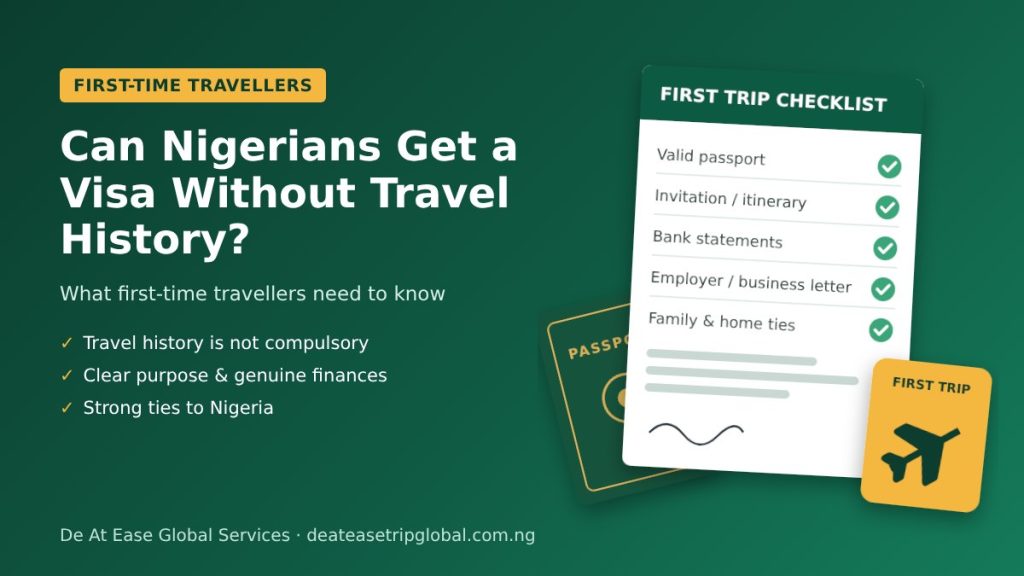
Quick answer: Yes. Nigerians can get a visa without travel history. No major destination, including the UK, Canada, the United States, the Schengen countries, Australia and China, requires previous international travel for a visitor visa. Travel history is one factor among many. When you have none, officers rely more on your other evidence: your reasons for the trip, your finances and your ties to Nigeria. A clean, well-supported first application can succeed. A strong travel history does not guarantee approval either.
Every traveller starts somewhere. Yet many first-time applicants believe an empty passport is an automatic refusal, and some are advised to make unnecessary “stamp-collecting” trips before applying for the UK or Canada. This visa without travel history Nigeria guide explains what travel history really means, how officers assess first-time travellers and how to prepare a strong first application.
What does “travel history” mean in a visa application?
Travel history is your record of previous international trips. It usually includes:
- visas you have been issued, and whether you used them correctly
- entry and exit stamps in current and previous passports
- countries visited, dates and length of stay
- any previous visa refusals or immigration problems
Officers care less about the number of countries you have visited and more about compliance: did you follow the rules and return on time?
Visa without travel history Nigeria: is travel history compulsory?
No. Official guidance treats it as helpful, not mandatory:
| Destination | What official guidance says |
|---|---|
| United Kingdom | Copies of previous passports showing travel are an optional supporting document (GOV.UK). Home Office caseworker guidance says travel history “should not be the only consideration” (Visit guidance). |
| Canada | Travel history is listed under recommended documents, as evidence that you have obtained visas before (IRCC). |
| United States | Officers consider your circumstances, travel plans, financial resources and ties outside the US (travel.state.gov). Previous travel is not a stated requirement. |
| Schengen | Consulates assess whether you intend to leave the Schengen area before your visa expires. Previous lawful use of Schengen visas can lead to longer multiple-entry visas, but it is not required for a first visa (EU Visa Code). |
| Australia | Visitor visa guidance does not require previous travel. You must have enough money for your stay (Home Affairs). |
| China | The Chinese Consulate in Lagos does not list travel history as a requirement. It sets category-specific requirements, such as group travel for tourists. |
How immigration officers assess first-time travellers
The UK’s caseworker guidance is unusually clear on this point. It says that where an applicant is a first-time traveller, the decision maker will “need to rely on other evidence”. In practice, that other evidence usually includes:
- A clear, believable purpose. Tourism, a family event, a conference or a business meeting, with supporting documents.
- A reasonable trip plan. The length and cost of the trip should suit your circumstances.
- Genuine finances. Funds that match your income and come from an explained source.
- Ties to Nigeria. Employment, business, studies, family, property and ongoing commitments.
- Consistency. Your form, documents and interview answers all tell the same story.
A first-time traveller with strong evidence in these five areas is often in a better position than a frequent traveller with weak or inconsistent documents.
Can having no passport stamps lead to refusal?
Having no passport stamps should not, on its own, be the reason for a refusal. The UK guidance says travel history should not be the only consideration. However, when you have no travel record, any weakness elsewhere becomes more visible. Refusals of first-time applicants usually come from:
- an unclear or unconvincing purpose of travel
- unexplained funds or unaffordable trip plans
- weak evidence of ties to Nigeria
- inconsistencies between the form and supporting documents
That is why preparation matters more for first-time travellers.
Should you travel elsewhere first to “build” travel history?
Not unless you genuinely want to make that trip. Travelling to nearby countries just to collect stamps costs money, may not impress an officer and does not replace the evidence they actually need. Apply for the trip you really want to make, and prepare it properly.
Documents first-time travellers should prepare
Always follow the checklist for your destination and visa type. A typical first-time visitor file includes:
Core documents
- valid international passport (and any previous passports)
- completed application form, with honest and consistent answers
- passport photographs, if required
- visa fee payment confirmation and appointment letter
Purpose of travel
- invitation letter from your host, event or company
- conference registration or business correspondence
- travel itinerary and accommodation details (see our hotel reservation and flight booking services)
Finances
- your own bank statements, plus sponsor documents if someone else is paying
- payslips, business records or other proof of income
For detailed guidance, see how much money you should have in your bank account and how to prepare a bank statement for a visa.
Ties to Nigeria
- employer letter confirming your role and approved leave
- business registration documents
- school enrolment letter
- marriage certificate and children’s birth certificates
- property or tenancy documents
How employment, business and family circumstances support your application
Employment. A stable job with approved leave shows you have something to return to. Canada’s guidance notes that an employer letter can confirm “you have a stable job and will return to it”.
Business ownership. An active, registered business with regular turnover and staff who depend on you is a strong tie. Provide CAC documents, business statements and tax records.
Family. A spouse, children or dependent parents in Nigeria are important ties, especially if they are not travelling with you.
If you are not currently employed, read our guide on applying for a visa without a job.
How financial documents affect first-time applications
With no travel record, your bank statement carries more weight. Officers look for a steady pattern of income and spending, funds that comfortably cover the trip and a clear source for any large credits. Avoid last-minute deposits that you cannot explain, as they are a common reason for doubts about first-time applicants.
Can a first-time traveller apply for a visa to each destination?
UK visa for first-time travellers
Yes. The UK does not require previous travel. The caseworker guidance says officers must rely on other evidence for first-time travellers, so focus on purpose, finances and ties. See our guide on how to apply for a UK visa from Nigeria.
US visa for first-time travellers
Yes. Under section 214(b), you must show strong ties to Nigeria. The State Department says strong ties “vary from country to country, city to city, and person to person”. Your interview matters, so prepare to explain your plans clearly. Read our guide to US visa interview questions.
Canadian visa for first-time travellers
Yes. Travel history is recommended, not required. First-time applicants should give particular attention to the recommended employer letter, bank statements and invitation letter. See our Canada visa requirements guide.
Schengen visa for first-time travellers
Yes. Your first Schengen visa will usually be issued for the length of your trip. Later visas may be issued for longer periods if you have used earlier visas lawfully. Read what Schengen embassies really check.
Australian visa for first-time travellers
Yes. Home Affairs advises including as much information as possible to support your application, as it may decide without asking for more. See our Australia visitor visa guide.
Chinese visa for first-time travellers
Yes, but follow the category rules set by the consulate. For example, the Lagos consulate asks Nigerian tourists to travel in a group with an invitation from an authorised Chinese travel agency. See our guide for first-time China visa applicants.
Practical examples of first-time Nigerian applicants
These are hypothetical illustrations, not official rules.
Ifeoma, 31, pharmacist, Port Harcourt – first trip, UK graduation of her brother. She has never travelled. She provides her employer letter with approved leave, six months of salary statements, her brother’s invitation letter and his graduation confirmation. Her purpose is clear and her finances fit the trip.
Yusuf, 45, poultry farm owner, Kaduna – first trip, agricultural trade fair in Germany. He submits his CAC documents, 12 months of business statements, the fair’s registration confirmation and evidence of his staff and ongoing contracts at home.
Ngozi and Chike, married teachers, Enugu – first family holiday in Canada. They travel without their two children, who stay with grandparents. They provide employer letters, school leave dates, bank statements and their children’s birth certificates.
Seun, 24, final-year student, Ile-Ife – first trip, conference in the US. His father sponsors him. He provides his university letter, conference invitation, his father’s statements and proof of relationship, and prepares to explain his plans after graduation.
Common mistakes first-time Nigerian travellers make
- Assuming an empty passport means automatic refusal. It does not.
- Making unnecessary trips just to collect stamps.
- Submitting fake documents, such as invented employment letters or edited statements. Deception can lead to long bans.
- Planning an unrealistic first trip, such as a long, expensive stay that does not match your income.
- Hiding previous refusals. Always disclose them truthfully when asked.
- Inconsistent answers between the form, documents and interview.
See our full guide to common visa application mistakes.
What to do after a visa refusal
A refusal is not the end of the road. Read the refusal letter carefully, as it explains why you were refused. Options differ by destination:
- UK: most visitor visa refusals have no right of appeal. You can submit a new application that addresses the reasons given. See our UK visa refusal guide.
- US: there is no appeal for 214(b) refusals. You can reapply, but you should be able to show significant changes in your circumstances.
- Canada: you can reapply with stronger evidence. Read our guide to Canada visa refusal reasons.
- Schengen: you have the right to appeal under the EU Visa Code, following the procedure in the refusal notice. See our Schengen visa rejection guide.
- Australia: the refusal letter states whether you have a right to review.
- China: see our guide to China visa refusal reasons.
Do not reapply immediately with the same documents. Fix the specific problems identified first.
Related guides: Why Nigerian Visa Applications Get Refused and How to Verify a Visa Agent in Nigeria.
Frequently asked questions
Can I get a UK visa with no travel history?
Yes. Travel history is not required. Home Office guidance says officers should rely on other evidence for first-time travellers.
Is it easier to get a Schengen visa first before applying for the UK or Canada?
Not necessarily. Each application is assessed on its own merits. Only travel if you genuinely plan that trip.
Will a blank passport lead to refusal?
Not on its own. Refusals usually come from weak purpose, unclear finances or weak ties, which become more noticeable when there is no travel record.
Should I submit my old passports?
Yes, if you have them and they show previous trips. Both the UK and Canada list previous passports as helpful evidence.
Does previous travel guarantee approval?
No. Each application is assessed on current circumstances and evidence.
Conclusion
A visa without travel history is achievable for Nigerians. Travel history is only one part of an overall assessment, and officers are expected to look at your other evidence when you have none. Focus on a clear purpose, genuine finances, consistent information and real ties to Nigeria. Preparation cannot guarantee approval, but it gives your first application the strongest possible start.
Planning your first trip abroad? Book a consultation with De At Ease Global Services, and we will help you review your documents before you apply.
De At Ease Global Services is an independent travel consultancy and is not affiliated with any embassy, government or visa application centre. Requirements change; always confirm with the official source before applying.