

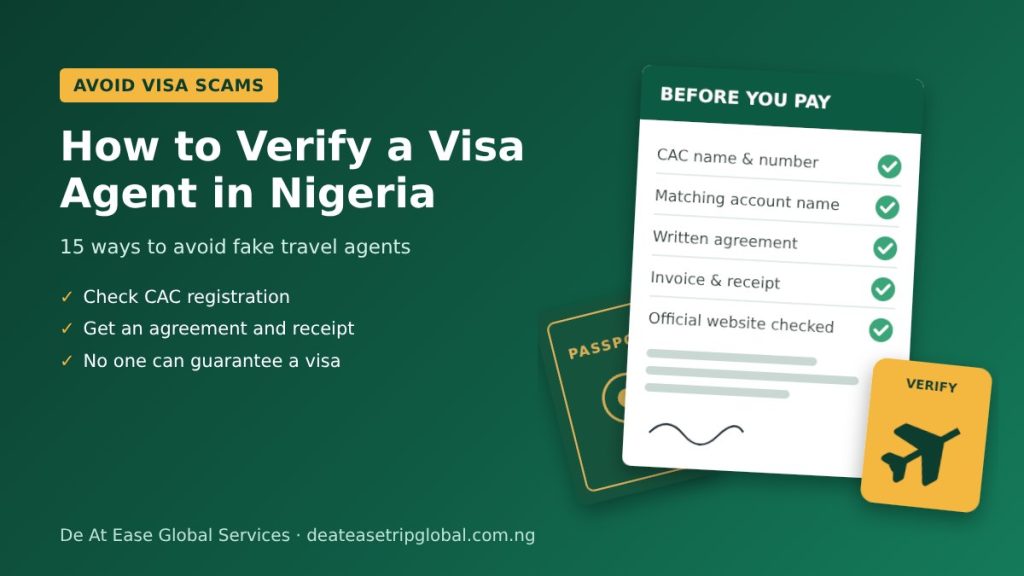
Quick answer: To verify a visa agent in Nigeria, check the business’s registration with the Corporate Affairs Commission (CAC), confirm that its name, contact details and online presence match, insist on a written agreement, an invoice and a receipt, and check every claim against the official embassy or visa application centre website. Be very cautious of anyone who guarantees approval, sells “embassy appointments”, asks you to pay into an unrelated personal account or offers to supply documents for you. CAC registration shows that a business legally exists. It does not prove that the agent is honest, qualified or approved by any embassy.
Every year, Nigerians lose money to people posing as visa agents. Some collect fees and disappear. Others sell fake job offers, fake appointment slots or forged documents that lead to refusals and, in some cases, long-term bans. This guide explains how to verify a visa agent in Nigeria, what legitimate visa assistance looks like and what to do if something goes wrong.
Why Nigerians must verify visa agents
The demand for travel help creates opportunities for fraud. Common problems include:
- fake visa agents who collect fees and stop responding
- fraudulent travel agencies using copied names or logos
- fake job and study visa offers with no real employer or school behind them
- false promises of guaranteed visa approval
- fake embassy appointment confirmations
- fraudulent flight and hotel reservations that cannot be verified
- agents collecting money and disappearing
A few careful checks before you pay can protect your money, your documents and your future travel record.
What is a visa agent?
What visa agents and travel consultants do
A visa agent or travel consultant is a private business that helps travellers prepare for a visa application or trip. Legitimate assistance may include:
- explaining the correct visa category and official requirements
- preparing a document checklist
- reviewing your documents for consistency
- helping you complete forms accurately
- booking flights and hotels
- explaining fees, appointments and timelines
What visa agents cannot do
A visa agent cannot issue visas, make or influence embassy decisions, sell guaranteed approvals or legally supply false documents. Only the embassy, consulate or immigration authority decides your application.
Understand who is who
| Type | What it is | What it does not mean |
|---|---|---|
| Registered business | A business registered with CAC | Not proof of honesty, expertise or embassy approval |
| Travel agency | A business selling travel services such as flights, hotels and tours | Not automatically qualified to advise on visas |
| Visa assistance consultant | A private business that helps applicants prepare | Cannot decide or influence visa outcomes |
| Official visa application centre | A company contracted by a government to collect applications, biometrics and fees (for example, VFS Global or the Chinese Visa Application Service Centre) | Does not decide visas |
| Immigration lawyer or regulated adviser | A professional regulated by a legal or immigration body, where the destination country requires it | Regulation depends on the country |
Some countries regulate who may be paid to represent you. Canada, for example, says that if you pay someone to represent you or give advice, they must be authorised. Authorised paid representatives are lawyers or paralegals in good standing with a Canadian law society, notaries with the Chambre des notaires du Québec, and licensed consultants registered with the College of Immigration and Citizenship Consultants. Other countries have their own rules.
15 ways to verify a visa agent in Nigeria
1. Check the company’s CAC registration
- What to check: Is the business registered with the Corporate Affairs Commission?
- How: Ask for the registered name and number, then search on CAC’s official public search portal (see the step-by-step section below).
- Warning signs: Refusal to share registration details, or details that cannot be found.
- If suspicious: Do not pay until you can confirm the registration yourself.
2. Verify the business name and RC or BN number
- What to check: That the registered name matches the name on the agent’s website, invoices and bank account.
- How: Compare the CAC record with every document the agent sends.
- Warning signs: A brand name that has no connection to the registered name, or an account name that matches neither.
- If suspicious: Ask for a clear explanation in writing.
3. Confirm that the business identity is genuine
- What to check: Whether the business can be identified and contacted consistently. A physical office helps, but some legitimate businesses operate remotely.
- How: Compare the address or service area on the CAC record, website and social media.
- Warning signs: Addresses that change, cannot be found or differ on each platform.
- If suspicious: Ask for a video call or more identifying information, and verify independently.
4. Check whether the company has a functioning website
- What to check: A real website with clear service descriptions, policies and contact details.
- How: Look for terms and conditions, a refund policy and a privacy policy.
- Warning signs: No website, a newly copied template, or pages that impersonate an embassy.
- If suspicious: Treat the agent as unverified.
5. Verify its official business email address
- What to check: Whether the business uses an email address linked to its own domain.
- How: Check that the email domain matches the website.
- Warning signs: Emails claiming to be from an embassy or visa centre but sent from free email accounts.
- If suspicious: Do not open attachments or follow payment instructions.
6. Check telephone and WhatsApp contact details
- What to check: Consistent phone and WhatsApp numbers across the website and social media.
- How: Call the number listed on the website, not one sent to you privately.
- Warning signs: Frequent number changes or contacts that only exist on WhatsApp.
- If suspicious: Pause until you can confirm who you are dealing with.
7. Examine social media accounts and business history
- What to check: How long the accounts have existed and whether their content is consistent.
- How: Look at older posts, name changes and comments.
- Warning signs: New accounts, bought followers, recent name changes or deleted comments.
- If suspicious: Look for independent evidence before trusting reviews.
8. Request a written service agreement
- What to check: A document explaining what the agent will and will not do.
- How: Ask for it before you pay.
- Warning signs: Refusal to put anything in writing.
- If suspicious: Do not proceed.
9. Request an official invoice and payment receipt
- What to check: An invoice and receipt in the business name.
- How: Ask for both for every payment.
- Warning signs: No receipt, or receipts in a different name.
- If suspicious: Stop further payments.
10. Confirm that services and charges are clearly explained
- What to check: A breakdown separating the agent’s service fee from embassy and visa centre fees.
- How: Compare official fees on the embassy or visa centre website.
- Warning signs: One lump sum with no explanation, or “embassy fees” far above the official amount.
- If suspicious: Ask for an itemised quotation.
11. Verify claims about embassy appointments
- What to check: That appointments are booked through the official system.
- How: Log in to the official portal yourself and confirm the booking.
- Warning signs: Agents selling “special” or “VIP” appointment slots. VFS Global states that it does not sell visa appointments.
- If suspicious: Do not pay for appointment slots.
12. Confirm visa procedures on official websites
- What to check: Requirements, fees and steps for your visa.
- How: Read the embassy, consulate or official government page. For example, UK visitor visas are applied for on GOV.UK.
- Warning signs: Steps or fees that do not match official guidance.
- If suspicious: Trust the official source.
13. Be suspicious of guaranteed approval claims
- What to check: Whether the agent promises a result it cannot control.
- How: Ask how they can guarantee a decision made by a foreign government.
- Warning signs: “100% guaranteed visa”, “no refusal” or “money-back visa”.
- If suspicious: Walk away.
14. Check reviews carefully and look for independent evidence
- What to check: Reviews on platforms the agent does not control.
- How: Look for detailed, balanced reviews over time.
- Warning signs: Only perfect reviews, identical wording or reviews posted on the same day.
- If suspicious: Ask people you know who have used the service.
15. Avoid agents who request false documents or encourage dishonesty
- What to check: Whether the agent suggests “arranging” bank statements, employment letters, invitations or bookings.
- How: Listen for phrases like “we will sort your statement” or “you don’t need real documents”.
- Warning signs: Any offer to create documents for you.
- If suspicious: Leave immediately. False documents can lead to refusals and long bans, such as the 10-year ban for deception under UK rules.
How to check whether a travel agency is CAC registered
What CAC registration means
CAC registration means a business has been registered under Nigerian law. Companies receive an RC number, while business names receive a BN number.
How to search for a registered business
- Ask the agent for their registered business name and RC or BN number.
- Visit the CAC’s official public search portal at search.cac.gov.ng. Use only the official CAC website, not a link sent to you by the agent.
- Search by business name or registration number.
- Compare the result with the agent’s advertised name, address and invoices.
- Check that the registration status appears active.
The portal’s layout and features can change, so follow the instructions on the official CAC website.
What CAC registration does not prove
CAC registration does not prove that a business is honest, experienced, qualified to give immigration advice or approved by any embassy. Fraudsters may also copy the name of a genuine registered business, so check that the bank account and contact details belong to the same entity.
Red flags that reveal a fake visa agent
- Guaranteed visa approval. Only embassies decide visas.
- Claims of special embassy connections. Legitimate agents do not claim to influence officers.
- Fake visa stamps or e-visas. Always verify visas through official channels.
- Fake invitation letters. For example, a China business invitation must come from the Chinese company itself and include its seal and details, according to official consulate guidance.
- Fake bank statements. These can lead to refusal and bans.
- Fake employment letters. Embassies may contact employers.
- Unusually cheap packages. Prices far below official fees are a warning.
- Pressure to pay immediately. Scammers rush victims.
- Payments to unrelated personal accounts. The account should match the business.
- No receipts. You need proof of payment.
- No written agreement. Terms should be clear.
- No verifiable business identity.
- Refusal to explain the process. Legitimate agents explain each step.
- Jobs abroad without verifiable employers. Check the employer and visa category independently.
- Claims that genuine documents are unnecessary.
How to verify an embassy appointment
- Find the official embassy website. Search for the embassy or consulate directly and check the address carefully.
- Find the correct visa application centre. Use the link on the official embassy or government website.
- Check your confirmation. Log in to the official portal yourself and confirm the booking reference.
- Avoid appointment sellers. VFS Global states that appointments can only be booked on its official website and that it does not sell appointments.
- Verify payment instructions. VFS Global says payments are made only on its official website or at its centres, and that it never asks for upfront payments by email, SMS or phone.
- Avoid impersonation websites. Check the domain name, spelling and security of every site.
Remember: visa application centres handle administrative tasks such as collecting documents, fees and biometrics. VFS Global states that it has no role or influence in visa decisions.
Questions to ask before paying a visa agent
- What is your registered business name?
- What is your CAC registration number?
- What exactly does your service fee cover?
- Which official visa category am I applying for?
- What documents will I need?
- Which embassy or visa centre handles the application?
- Will I receive an invoice and receipt?
- Will I have access to my application reference?
- Who will submit my application?
- Are embassy and visa centre fees included?
- What happens if my visa is refused?
- Which charges are refundable?
- Will you provide a written service agreement?
- Can I verify the information independently?
- Will I keep control of my passport and personal documents?
- Which bank account will I pay into, and in whose name?
Clear answers suggest transparency. Evasive answers are a warning sign.
What should a legitimate visa agent provide?
Not every item below is a legal requirement for every business, but each is good business practice:
- business identity and registration details
- a clear description of services
- a written quotation
- an invoice
- a payment receipt
- a service agreement
- a document checklist
- application guidance based on official sources
- clear, consistent communication
- refund and cancellation terms
- information on how your personal data and documents are handled
What to do if a visa agent scams you
- Stop sending money, even if you are promised a refund or “final step”.
- Preserve evidence, including WhatsApp messages, emails, call logs and screenshots.
- Keep invoices, receipts and transaction references.
- Contact your bank or payment provider promptly and ask about options for the transaction.
- Report to the appropriate authorities (see below).
- Report fake accounts to the social media platform or website host.
- Stay safe. Do not threaten or confront suspected fraudsters in person.
Official reporting channels
- EFCC handles economic and financial crimes. Its official website provides a petition submission option, the EFCC Eagle App and the email info@efcc.gov.ng.
- Nigeria Police Force National Cybercrime Centre runs an online cybercrime reporting portal for online fraud.
- FCCPC handles consumer complaints. You can file a complaint on its complaints portal or email contact@fccpc.gov.ng.
Can a visa agent guarantee visa approval?
No. Visas are decided by the embassy, consulate or immigration authority of the destination country. Even IRCC notes that using a representative does not mean your application will be approved. A legitimate agent can help you understand the requirements, prepare accurate documents and avoid mistakes, but cannot control the outcome. Treat any guarantee as a serious warning sign.
Fictional Nigerian examples
These examples are fictional illustrations.
UK visitor visa. Bola, from Ibadan, pays an agent ₦600,000 for a UK visitor visa. The agent cannot explain what the fee covers or show the GOV.UK application. Bola later finds that no application was submitted.
“Guaranteed” Canadian visa. Sam, from Port Harcourt, is promised a guaranteed Canadian visa within two weeks. He checks IRCC’s website, learns that paid representatives must be authorised and that no one can guarantee approval, and decides not to pay.
Fake China invitation letter. Uche, a trader in Aba, buys an invitation letter from a stranger online. It has no company seal and names a company his supplier has never heard of. His application is refused.
Fraudulent overseas job. Amina receives a WhatsApp job offer in Europe with “free visa processing” after a ₦300,000 fee. The employer cannot be found on any official register.
Payment to an unrelated personal account. Tayo is asked to pay into an account in a name that does not match the agency. She asks for an explanation, receives none and stops the transaction.
A legitimate agency. Ngozi contacts a registered travel agency. Before she pays, it gives her a written quotation, an agreement listing its services, an invoice in the business name and a receipt. It separates its fee from the official visa fee and explains that the embassy decides.
How De At Ease Global Services works
De At Ease Global Services is a CAC-registered visa and travel consultancy based in Anambra State, serving clients across Nigeria by WhatsApp, phone and email. Our registration details are published on our About page, so you can check them yourself.
We help travellers with visa application guidance, including China, UK and Canada, as well as flight booking and hotel reservations. We separate official fees from our own service charge, never promise guaranteed visas, and never use or arrange fake documents. Our refund policy and terms and conditions are published on our website.
We are not an embassy, a visa application centre or a law firm, and we cannot influence visa decisions.
Related guides: Why Nigerian Visa Applications Get Refused and Can Nigerians Get a Visa Without Travel History? What First-Time Travellers Need to Know.
Frequently asked questions
How can I check if a visa agent is genuine in Nigeria?
Verify CAC registration, consistent contact details and online presence, ask for a written agreement and receipt, and check all claims on official embassy websites.
How do I verify a travel agency’s CAC registration?
Ask for the registered name and RC or BN number, then search on CAC’s official public search portal and compare the details.
Does CAC registration mean a visa agent is trustworthy?
No. It shows the business exists legally, not that it is honest, qualified or embassy-approved.
Can a visa agent guarantee visa approval?
No. Only the embassy or immigration authority decides.
How do I identify a fake visa consultant?
Look for guarantees, pressure to pay, no receipts, personal bank accounts and offers to supply documents.
Should I pay a visa agent into a personal bank account?
Be cautious. The account name should match the registered business. Ask for an explanation and a receipt.
What documents should a legitimate visa agent provide?
As good practice: a quotation, an invoice, a receipt, a service agreement, a document checklist and clear refund terms.
How can I verify a visa appointment?
Log in to the official embassy or visa centre portal yourself and confirm the booking reference.
Can I apply for a visa without using an agent?
Yes. Many applications can be completed by applicants themselves. IRCC, for example, says you do not need to hire a representative.
What should I do if a visa agent collects my money and disappears?
Stop paying, preserve evidence, contact your bank and report to the EFCC, the Police cybercrime portal or the FCCPC as appropriate.
Can a visa agent keep my passport?
Your passport belongs to you, and you should know where it is at all times. Only hand it over when necessary for a specific step, such as submission at a visa centre, and get a written acknowledgement.
How do I report a fake travel agency in Nigeria?
Report fraud to the EFCC or the Police cybercrime portal, and consumer issues to the FCCPC. Report fake profiles to the platform.
Are embassy-approved visa agents available in Nigeria?
Some embassies appoint official visa application centres or, in some cases, specific agencies. Check the embassy’s own website. Do not rely on an agent’s claim alone.
How much should a legitimate visa agent charge?
There is no single official rate. Service fees should be clearly separated from embassy and visa centre fees and agreed in writing.
What is the difference between a visa agent and an official visa application centre?
A visa application centre is contracted by a government to collect applications and biometrics. A visa agent is a private business that helps you prepare. Neither decides your visa.
Conclusion
Knowing how to verify a visa agent in Nigeria can save you money, time and your travel record. Check registration, insist on written terms and receipts, confirm everything on official websites and walk away from guarantees or fake documents. A trustworthy agent will welcome your questions.
Need honest travel and visa guidance? Visit deateasetripglobal.com.ng, contact our team or book a consultation. You can also read our guides on common visa application mistakes and how to prepare a bank statement for a visa.
This article is for general information only and is not legal advice. Always confirm requirements with the relevant embassy, consulate or authority.