

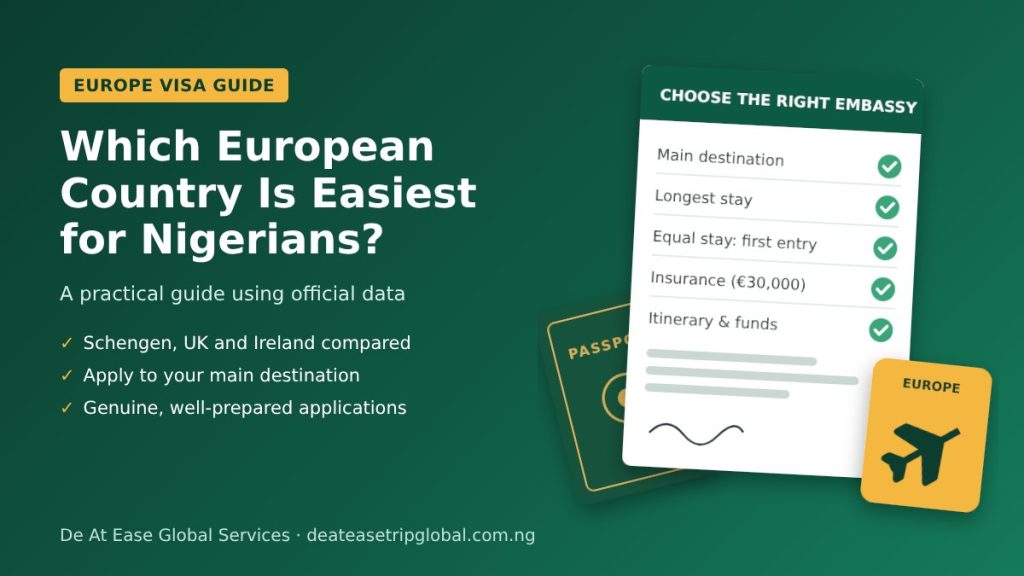
Quick answer: There is no single “easiest” European country for every Nigerian applicant. Official European Commission data for 2025 shows that some Schengen embassies in Nigeria refused a smaller share of applications than others: Switzerland and Germany had the lowest refusal shares among the main embassies. However, Schengen rules say you must apply to the country that is your main destination, so you cannot simply choose the embassy with the best figures. Outside the Schengen area, the UK and Ireland run their own separate visa systems. The best choice is the country you genuinely plan to visit, backed by a strong, honest application.
Searches for the “easiest European country” are common among Nigerian travellers. This guide looks at the European countries Nigerians can visit, how the Schengen system works, what the official numbers really show and how to prepare an application that gives you a fair chance wherever you are going.
What is a Schengen visa?
A Schengen visa is a short-stay visa (often called a “type C” visa) that lets you visit the Schengen area for up to 90 days in any 180-day period. One visa covers travel across all Schengen countries, but you apply to the consulate of one specific country.
Which European countries issue Schengen visas?
The Schengen area includes most EU countries and four non-EU countries. As of 2026, it covers:
Austria, Belgium, Bulgaria, Croatia, Czech Republic, Denmark, Estonia, Finland, France, Germany, Greece, Hungary, Iceland, Italy, Latvia, Liechtenstein, Lithuania, Luxembourg, Malta, the Netherlands, Norway, Poland, Portugal, Romania, Slovakia, Slovenia, Spain, Sweden and Switzerland.
European countries Nigerians can visit outside the Schengen area
Some popular European destinations are not part of Schengen and need their own visas:
- United Kingdom. The UK Standard Visitor visa costs £135 for up to six months, according to GOV.UK. See our guide to UK visitor visa requirements for Nigerians.
- Ireland. Ireland issues its own short-stay “C” visa. Applications are made online through the Irish immigration service, and its guidance names Abuja among its visa offices. Ireland’s Short-stay Visa Waiver Programme, which lets some UK visa holders visit Ireland, does not currently include Nigeria. See our Ireland tourist visa guide.
- Cyprus. An EU member that is not yet a full Schengen member, so it issues its own national visas.
A Schengen visa does not let you enter the UK or Ireland, and a UK visa does not let you enter the Schengen area.
Which countries may be more accessible for Nigerians? What the official data shows
Every year, the European Commission publishes visa statistics for each Schengen consulate worldwide. The 2025 dataset, published in May 2026, shows the following for Schengen consulates in Nigeria (Abuja and Lagos combined):
| Schengen state | Applications in Nigeria (2025) | Visas issued | Not issued as a share of applications |
|---|---|---|---|
| France | 58,583 | 29,375 | 47.4% |
| Italy | 13,563 | 7,804 | 42.5% |
| Spain | 9,489 | 3,669 | 52.7% |
| Germany | 7,712 | 5,417 | 29.1% |
| Belgium | 7,461 | 2,860 | 60.3% |
| Portugal | 3,026 | 1,313 | 56.6% |
| Switzerland | 2,597 | 1,805 | 27.2% |
| Bulgaria | 2,453 | 712 | 56.7% |
| Denmark | 2,434 | 964 | 57.6% |
| Austria | 1,735 | 960 | 35.8% |
| Finland | 1,630 | 734 | 55.2% |
| All Schengen consulates in Nigeria | 113,359 | 57,061 | 46.9% |
Source: European Commission, visa statistics for consulates, 2025. The percentage is calculated as visas not issued divided by applications. The Commission’s own “not issued rate” uses a slightly different formula, so its published rates can differ by a few points.
For comparison, the European Commission reported a worldwide Schengen refusal rate of 14.6% in 2025. For a full embassy-by-embassy breakdown, read our guide to the easiest Schengen visa country for Nigerians.
How to interpret visa refusal rates
Refusal rates are useful, but they are easy to misread:
- They describe past applicants, not you. A lower rate may reflect who applies to that embassy, for example more business travellers or repeat visitors.
- Small numbers can mislead. An embassy that handles a few hundred applications can show large swings from year to year.
- Purpose matters. Business, family and tourist applications are mixed together in the figures.
- Rates change. Embassy staffing, policies and applicant profiles change every year.
Approval rates versus your personal chance of approval
A 27% refusal rate does not mean you have a 73% chance of approval. Each application is assessed individually on its own evidence. A well-documented application to an embassy with a higher refusal rate can succeed, while a weak application to an embassy with a lower rate can fail. Your circumstances, purpose, finances and ties to Nigeria matter far more than any national average.
How to choose the correct embassy: the main-destination rule
This is the rule that matters most. According to the European Commission, you must apply to:
- The country you are visiting, if you are visiting only one Schengen country.
- The country where you will spend the longest time, if you are visiting several countries.
- The country you will enter first, if you will spend an equal amount of time in each.
Do not apply through a country you do not genuinely intend to make your main destination because of its refusal figures. Officers check itineraries, and border guards may ask about your travel plans. Misusing the system can lead to refusal, visa cancellation or problems with future applications.
If you have a real choice, for example a holiday where you have not yet decided where to spend most of your time, plan an itinerary you genuinely intend to follow and apply to the correct embassy.
Schengen visa requirements for Nigerians
Requirements vary slightly by embassy, but a typical application includes:
- a valid passport issued within the last 10 years, with at least two blank pages and valid for at least three months after you leave the Schengen area
- a completed and signed Schengen visa application form
- recent passport photographs
- travel medical insurance
- proof of accommodation
- travel itinerary or flight reservation
- bank statements and proof of income
- employer letter, business documents or school letter
- invitation letter, if visiting family, friends or a business partner
For a full checklist, see our Schengen visa requirements for Nigerians guide.
Bank statement and financial requirements
You must show sufficient means of subsistence for your stay and return journey. Each Schengen country sets its own daily reference amount. Embassies in Nigeria commonly ask for recent personal bank statements. The Danish embassy in Nigeria, for example, asks for three months of statements.
Officers look for steady income, explained deposits and funds that match your circumstances. Read our guides on how much money you should have in your bank account and how to prepare a bank statement for a visa.
Travel itinerary and accommodation requirements
Your itinerary shows the officer which countries you will visit and for how long. It also proves you have applied to the right embassy. Provide:
- flight reservations showing entry and exit dates
- hotel bookings, or an invitation letter if staying with a host
- a day-by-day plan if visiting several countries
We can help with flight bookings and hotel reservations that match your travel plans.
Travel insurance requirements
Travel medical insurance is compulsory for Schengen visas. Under the EU Visa Code, it must cover emergency medical care, hospital treatment and repatriation, with minimum cover of €30,000, valid throughout the Schengen area for your whole stay.
How to apply for a European visa from Nigeria
- Decide your main destination using the rules above.
- Check that country’s official embassy or visa centre website for the Nigeria-specific checklist.
- Book an appointment. Many Schengen embassies in Nigeria use external visa application centres.
- Prepare your documents according to the checklist.
- Attend your appointment to submit documents, pay fees and give fingerprints.
- Wait for a decision and track your application.
According to the European Commission, you can apply no earlier than six months and at least 15 days before your trip.
Schengen visa fees and processing times
| Item | Official position |
|---|---|
| Visa fee (adults) | €90 |
| Visa fee (children aged 6 to under 12) | €45 |
| Normal processing time | 15 days |
| Extended processing | Up to 45 days if further examination is needed |
Source: European Commission. Visa centres may charge an additional service fee. Fees are often paid in naira at the exchange rate set by the embassy or centre.
Common reasons for Schengen visa refusal
- doubts about your intention to leave the Schengen area before your visa expires
- insufficient or unexplained funds
- unclear purpose of travel or unreliable itinerary
- applying to the wrong embassy for your main destination
- missing or inadequate travel insurance
- inconsistent or false documents
If you have been refused, see our guide to Schengen visa rejection for Nigerians. The EU Visa Code gives you the right to appeal a refusal.
Tips for preparing a genuine application
- Apply to the correct embassy for your real travel plans.
- Apply early, especially before summer.
- Make your story consistent across your form, itinerary, bank statements and letters.
- Explain any large deposits with documents.
- Show strong ties to Nigeria, such as your job, business, studies or family.
- Never submit false documents, including fake bookings or employment letters.
First-time travellers can read our guide on getting a visa without travel history.
Practical Nigerian examples
These are hypothetical illustrations, not official rules.
Kunle, banker, Lagos – one week in Paris. France is his only destination, so he applies to France, even though other embassies had lower refusal rates in 2025.
Aisha, doctor, Abuja – conference in Berlin, then three days in Prague. She spends five nights in Germany and three in the Czech Republic. Germany is her main destination, so she applies there.
Emeka and Chioma, married couple, Enugu – eight-day tour of Italy, Switzerland and France. They spend four nights in Italy and two in each of the others. Italy is their main destination.
How De At Ease Global Services can help
De At Ease Global Services is a travel and visa assistance company serving Nigerian travellers. We can help you work out which embassy is responsible for your trip, review your documents against official checklists and arrange flight and hotel reservations that match your plans. We do not make visa decisions and cannot guarantee approval, but we help you submit a clear, genuine and well-organised application.
Related guides: Schengen Visa for Nigerians.
Frequently asked questions
Which European country is easiest for Nigerians to get a visa?
No country is easiest for everyone. In 2025, Switzerland and Germany had the lowest refusal shares among the main Schengen embassies in Nigeria, but you must apply to your main destination.
Can I apply to Switzerland or Germany if I am mainly visiting France?
No. You must apply to the country where you will spend the most time. Applying elsewhere to get a perceived better chance can lead to refusal or problems at the border.
Is the UK part of the Schengen area?
No. The UK and Ireland have their own visa systems. A Schengen visa does not allow entry to either.
How much is a Schengen visa for Nigerians?
The official fee is €90 for adults and €45 for children aged 6 to under 12, plus any visa centre service charges.
How long does a Schengen visa take?
Normally 15 days, extendable to 45 days if the embassy needs more information.
Conclusion
There is no shortcut to Europe. The European countries Nigerians can visit each have their own rules, and the official refusal data, while useful, does not decide your individual outcome. Apply to the country you genuinely plan to visit, follow the main-destination rule, and present honest, consistent evidence.
Need help understanding the process? Book a consultation with De At Ease Global Services, explore our Schengen visa assistance service, or read our guides for France, Germany and Spain.
De At Ease Global Services is an independent travel consultancy and is not affiliated with any embassy, the European Commission or any visa application centre. Requirements and fees change; always confirm with official sources before applying.