

Quick answer: How much money should I have in my bank account before applying for a visa? For most visitor visas, there is no fixed minimum bank balance. The UK, Canada, the United States and Australia do not publish a set amount for tourist or family visits. Officers want to see that you can pay for your trip without strain, that the money is genuinely yours and that your finances match your job and lifestyle. Fixed amounts mainly apply to student visas, and some Schengen countries publish daily reference amounts. The right figure for you depends on your destination, visa type, length of stay and who is paying.
“How much should be in my account?” is one of the first questions Nigerian applicants ask. Unfortunately, it is also one of the most misunderstood. Many people search for a “bank statement for visa Nigeria” figure, hoping to find one number that works everywhere. Some agents quote a “magic number”, such as ₦5 million or ₦10 million, for every visa. That figure does not come from any embassy, and having it in your account does not mean you will be approved.
This guide explains how officers actually think about money, so you can work out a sensible figure for your own trip. If you want to know how to obtain and organise the statement itself, read our step-by-step guide on how to prepare a bank statement for visa applications.
Is there a fixed minimum bank balance for visa applications?
For visitor visas, generally no. Here is what official sources say:
| Destination | Visitor visa | Student visa |
|---|---|---|
| United Kingdom | No fixed amount. You must show you can support yourself for the whole trip (GOV.UK). | £1,529 per month in London or £1,171 per month elsewhere, for up to 9 months, held for 28 consecutive days (GOV.UK). |
| Canada | No minimum stated. Statements help IRCC see if you have “enough money to support yourself” (IRCC). | CAN$23,448 a year for a single applicant outside Quebec, plus tuition, for applications from 1 September 2026 (IRCC). |
| United States | No published minimum. The consular officer assesses your circumstances at the interview. | Funds must cover the costs shown on your school’s Form I-20. |
| Schengen | Each country sets its own daily reference amount for means of subsistence (European Commission). | Set nationally by each country. |
| Australia | You must have enough money for your stay (Home Affairs). | Set by Home Affairs; check the current subclass 500 figure before applying. |
| China | No minimum stated by the Chinese Consulate in Lagos. F and M visas need six months of statements. | X1 and X2 visas: proof of US$2,500 per year or a scholarship certificate. |
Figures change, so always confirm on the official page on the day you apply.
How immigration officers assess your financial circumstances
Officers are not only looking at your closing balance. They ask four questions:
- Can you afford this trip? The cost of the trip should make sense next to your income and savings.
- Is the money yours? UK guidance says financial documents must clearly show you have access to the funds.
- Where did the money come from? A steady salary is easy to follow. A sudden large credit is not.
- Does it fit your story? Your job, income, travel plans and spending should all point in the same direction.
A civil servant earning ₦400,000 a month with ₦25 million in savings may face more questions than one with ₦1.8 million saved steadily over two years. The second profile is easier to believe.
How travel duration affects the money you may need
The longer you stay, the more you need. A five-day business visit to Germany costs far less than a six-week family visit to Canada. Officers compare your funds with:
- the number of days you plan to spend abroad
- whether you are staying in a hotel or with family
- how many people are travelling with you
- your continuing expenses at home, such as rent, school fees and family support
That last point matters. If your trip would use almost all your savings, an officer may doubt that the plan is realistic.
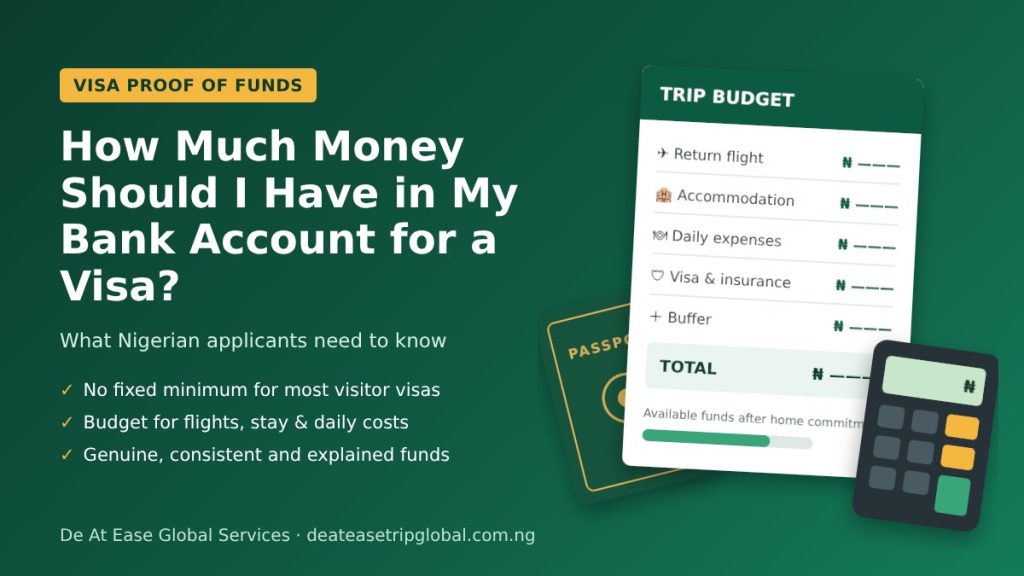
How much money should I have in my bank account? Build a trip budget from flights, accommodation and daily costs
A practical way to estimate a sensible figure is to build a simple trip budget:
- Return flight – check current fares for your dates. Our flight booking service can help you price options.
- Accommodation – hotel cost per night multiplied by the number of nights, or zero if a host is genuinely providing accommodation. See our hotel reservation services.
- Daily spending – food, local transport and activities.
- Visa and insurance costs – including travel medical insurance where required (Schengen applications require it).
- A buffer – for emergencies and exchange-rate movement.
Convert foreign costs to naira at the exchange rate on the day you apply. Your available funds should comfortably cover this total after your normal monthly commitments at home.
For Schengen trips, also check the daily reference amount published by the country you are applying to. Our guides for France, Germany and Spain cover country-specific details.
Bank statements for salaried employees
Salaried applicants are usually the easiest to assess. Officers expect to see:
- regular salary credits that match your payslips and employer letter
- normal spending, such as rent, transport and bills
- savings that build up over time
Submit the account your salary is paid into. A letter from your employer confirming your role, salary and approved leave adds weight. Canada’s visitor guidance, for example, asks for an employer letter on official letterhead stating your salary.
Bank statements for business owners and self-employed applicants
Business income is often irregular, and that is fine if it is explained. Officers want to see that your business is real and that you personally benefit from it. Helpful evidence includes:
- your personal bank statement, showing transfers from the business
- your business bank statement
- CAC registration documents
- tax clearance certificate
- invoices, contracts or management accounts
Business funds belong to the company. Do not assume an officer will treat a large business balance as your personal travel money.
Financial evidence for students and unemployed applicants
Students applying for study visas must usually meet a published amount (see the table above) and show it in the format required. For example, UK student funds must be held for 28 consecutive days, ending within 31 days of the application. Our student visa service can help you check this.
Students on a visitor visa (for example, visiting family during holidays) usually rely on a parent or guardian as sponsor, plus a letter from their school.
Unemployed applicants can still apply, but they need to show how the trip will be funded and why they will return. This might be a sponsor, savings from previous work, rental income or pension. Be honest on the form about your employment status.
How sponsors can support you financially
A sponsor can be a parent, spouse, sibling, employer or host abroad. The UK’s guidance says you should show what support is being given, how it will be provided and that the sponsor has enough funds. A good sponsor pack usually includes:
- a signed letter stating what the sponsor will pay for
- the sponsor’s bank statements and proof of income
- proof of your relationship (birth or marriage certificate)
- a copy of the sponsor’s ID or passport
The sponsor’s finances are assessed in the same way as yours: steady, explained and affordable.
What happens if your bank balance is low?
A modest balance is not automatically a refusal. A short trip, a credible sponsor or free accommodation with family can all reduce what you need. Problems arise when:
- the balance cannot realistically cover the trip
- the trip would leave you with nothing for your obligations at home
- your income and spending do not match your declared job
If your savings are genuinely low, the honest options are to save over a longer period, shorten the trip, or apply with proper sponsor support.
Why unexplained large deposits raise questions
A large credit shortly before applying is one of the most common red flags in Nigerian applications. Officers may suspect “funds parking”, where money is borrowed and placed in an account temporarily to inflate the balance.
A large deposit is not a problem if it is genuine and documented: for example, the sale of land with a sale agreement, a bonus with an employer letter, or a contract payment with an invoice. Never borrow money to boost your balance for an application. Submitting misleading financial information can lead to refusal and, under UK rules, deception can attract a 10-year ban (Immigration Rules, Part Suitability).
Practical Nigerian examples
The figures below are hypothetical illustrations, not official requirements.
Adaeze, bank officer, Lagos – UK visit for 7 days. She earns ₦650,000 net per month and has saved ₦3.2 million over 18 months. Her estimated trip cost, including flights and hotel, is a fraction of her savings, and she still has funds for rent and family obligations. Her profile is consistent.
Ibrahim, trader, Kano – China business trip (M visa). His shop’s account shows turnover between ₦4 million and ₦9 million monthly. He submits six months of business and personal statements, his business name registration and an invitation from a Chinese supplier, as the consulate requires.
Kemi, 22, unemployed graduate, Ibadan – Canada family visit. She has ₦180,000 in her account. Her uncle in Toronto invites her and provides his employment letter and bank statement; her father in Nigeria provides his statement and a sponsorship letter. Her low balance is explained by credible sponsorship.
Chinedu, civil engineer, Abuja – France holiday. His account jumped from ₦900,000 to ₦7.5 million two weeks before applying. The money came from selling a plot of land. He includes the sale agreement and buyer’s payment evidence. Without those documents, the deposit would look suspicious.
Common financial mistakes that can affect visa applications
- Believing a “fixed balance” quoted by an agent.
- Borrowing money to inflate your balance.
- Showing a balance that does not match your declared income.
- Submitting only a business account with no personal statement.
- Ignoring obligations at home when planning trip costs.
- Leaving large deposits unexplained.
- Submitting edited or “regenerated” statements. This is fraud.
See our full list of common visa application mistakes.
Related guides: Can I Apply for a Visa Without Having a Job? A Guide for Nigerians and Why Nigerian Visa Applications Get Refused.
Frequently asked questions
How much money should I have in my bank account for a visa from Nigeria?
There is no single figure. For most visitor visas, you need enough to cover your trip comfortably without draining your savings, and your funds should match your income. Student visas usually have published amounts.
Is ₦5 million enough for a UK or Canada visitor visa?
No fixed amount guarantees approval. ₦5 million may be more than enough for one applicant and suspicious for another if the source is unclear. Consistency and genuineness matter more than the number.
Do I need to show funds in foreign currency?
Not necessarily. For visitor visas, a naira account statement is normally acceptable, and you do not need to convert your savings into foreign currency. A domiciliary account can help if your income is genuinely earned in foreign currency.
Can my sponsor’s bank statement replace mine?
A sponsor’s statement can support your application, but submit your own statement too if you have one.
How long should money be in my account before applying?
There is no general rule for visitor visas, but funds that have built up over months are more convincing. UK student visas require funds held for 28 consecutive days.
Conclusion
So, how much money should I have in my bank account? There is no universal amount you need in your bank account before applying for a visa. What matters is that your funds are genuine, consistent with your income and enough for the trip you are planning. Check the official requirements for your destination, build a realistic budget and document where your money came from. This does not guarantee approval, but it gives the officer a clear and credible picture.
Need a second opinion before you apply? Book a consultation with De At Ease Global Services. For country-specific guidance, read our articles on UK visa bank statement requirements, Canada visa requirements, Australia visitor visa, China visa requirements and US visa interview questions.
De At Ease Global Services is an independent travel consultancy and is not affiliated with any embassy, government or visa application centre. Requirements change; always confirm with the official source before applying.